
Right, let’s get into it. If you’ve been quietly stalking the Cardiff University UK website at 2am, comparing tuition fees on six tabs, and wondering whether Wales is actually a country or some sort of regional add-on to England — you’re in the right place. (It is a country. With its own language. And a really, really strong rugby culture.)
I’ll be honest with you upfront. Most “guides” to UK universities read like brochure copy stitched together by someone who’s never set foot in the country. This one is different. We’ve helped hundreds of students from South Asia, Africa, the Middle East and Europe land at Cardiff over the years at Uni Student HUB, and the questions we hear over and over again rarely show up in the polished prospectuses. So this is the slightly messier, more honest take.
Why Cardiff University UK Stands Out in the Russell Group
Cardiff University was founded in 1883. It’s the only Welsh member of the Russel Group that’s the cluster of 24 research-heavy UK institutions that hoover up roughly two-thirds of all university research funding in the country. Being in this group matters more than most international students realise. When employers see “Russell Group” on a CV, doors open quietly. Recruiters in London, Dubai, Singapore — they know the label.
The numbers from 2026 are quietly impressive for Cardiff University UK:
- #1 in Wales according to The Times and Sunday Times Good University Guide 2026
- #181 in QS World University Rankings 2026– Cardiff is Wales’s highest ranked university
- Top 25 in the UK per the Complete University Guide
- 90% of research rated world-leading or internationally excellent in REF 2021
- Eight subjects in the global top 100 per QS World Rankings by Subject
Three of those subjects sit in the global top 50. Dentistry. Communication and Media Studies. And one more depending on which year you check. Journalism at Cardiff is somewhat famous in UK education circles — the School of Journalism, Media and Culture has produced presenters and editors at the BBC for decades. If you want to study media in the UK, this is one of three or four names that come up first.
But rankings are only part of the picture. The thing nobody mentions? Cardiff is liveable in a way Manchester or Birmingham aren’t always. The city is small enough to walk across in 40 minutes, big enough to have a proper nightlife, and cheap enough that you can survive on a part-time job income without crying into your beans on toast every Sunday.
The Money Conversation Nobody Wants to Have First
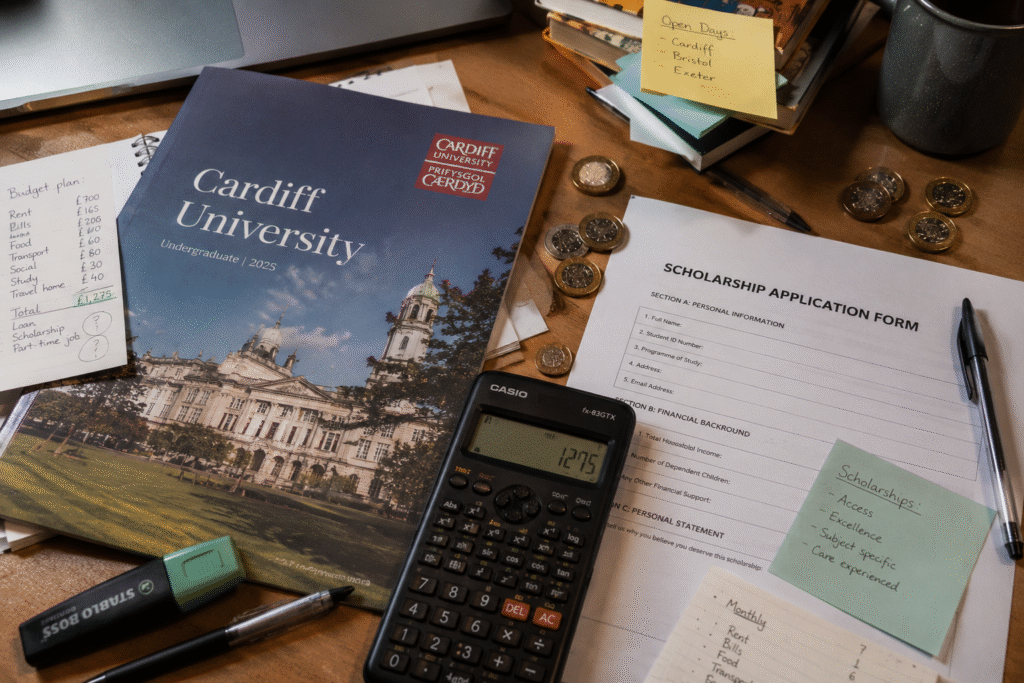
Tuition. Let’s just rip the plaster off.
International undergraduate fees at Cardiff University UK for the 2025/26 cycle generally run between £22,450 and £25,450 for most programmes. Specialist courses — particularly anything involving clinical training — climb significantly higher. Medicine and Dentistry can push past £44,000 per year once you hit clinical stages.
Postgraduate taught programmes typically sit between £19,450 and £30,200 annually for international students. Then there’s living costs. UKVI requires international students to show £1,136 per month for study outside London. Cardiff is genuinely one of the cheaper Russell Group cities to live in — most students get by on £1,000–£1,200 a month including accommodation, food, transport and the occasional pint.
| Cost Category | Approximate Annual Cost (£) | Notes |
|---|---|---|
| UG Tuition (most courses) | £22,450 – £25,450 | Higher for Medicine/Dentistry |
| PG Taught Tuition | £19,450 – £30,200 | Business and Computing on the higher end |
| Accommodation (university halls) | £6,800 – £9,500 | 39-week contracts standard |
| Food & groceries | £2,400 | Cooking at home; eating out adds up fast |
| Transport | £400 – £600 | Most students walk or cycle |
| Other (books, social, phone) | £1,400 | Wildly variable |
A small warning, written in capitals in my head: Do not — and I mean DO NOT — assume the headline tuition fee is what you’ll actually pay. Cardiff has a postgraduate deposit requirement that scoops out £2,000 from your wallet before you even land. Plan for it.
Scholarships do exist, and a surprising number of applicants don’t bother trying. The Vice-Chancellor’s International Scholarship offers between £3,500 and £10,000 to postgraduate students. The Undergraduate International Excellence Scholarship can knock 50% off your tuition. For Indian students specifically, there’s a £5,000 India Scholarship that runs most years. Apply. Even if you think you won’t get one. Apply.
This is the bit where, honestly, having a decent consultant pays for itself ten times over. Our team at Uni Student HUB spends a chunk of every week mapping students to the right scholarships and prepping deposit waivers. It’s tedious, but it works.
A Quick Detour Into Cardiff Itself
Before we get to the academic bit, can I rant for a second?
Cardiff is underrated. Really underrated. The Welsh capital sits on a coastline, has a literal castle in the middle of the city centre, and somehow nobody talks about it the way they talk about Edinburgh or York. Cardiff Bay alone is worth the move — old shipping warehouses converted into restaurants, the Wales Millennium Centre lit up at night, a freshwater lagoon. The Principality Stadium drops 74,500 rugby fans into the city centre on match days and the energy is genuinely something to experience once.
International students from warmer climates will complain about the weather. I’m not going to lie to you. It rains. A lot. But you adapt. Buy a proper coat in October and stop wearing trainers in winter.
Picking a Cardiff University UK Course Without Losing Your Mind
Cardiff offers more than 300 undergraduate and 200 postgraduate programmes across 26 academic schools. That’s a lot. Most international students cluster around a handful of disciplines — and there’s a reason for that.
Where Cardiff genuinely shines:
- Journalism, Media and Communication — globally top 50, with extraordinary BBC partnerships
- Architecture and Built Environment — top 100 worldwide, beautiful Bute Building studios
- Dentistry — one of the most competitive entry points in the UK
- Psychology — the school is in the top 100 globally and runs serious research
- Engineering — Civil Engineering particularly strong, with the Cardiff University Brain Research Imaging Centre nearby for cross-disciplinary work
- Healthcare and Nursing — sits on the Heath Park campus, sharing space with the University Hospital of Wales
If you’re looking at postgraduate options across the UK, Cardiff’s MSc programmes in business, data science, public health and international relations attract particularly large international cohorts. For something more focused, the insider’s guide to UK masters programs covers what you actually need to prepare.
For students chasing healthcare — and there are many — Cardiff’s clinical programmes are tightly bound to NHS Wales placements. Worth checking our guide to UK nursing scholarships and NHS funding before you decide. The funding landscape changes more often than the websites update.
And for the law-curious among you — Cardiff’s law school has a long, respected tradition, particularly in legal practice and human rights. The complete UK law admissions guide we put together walks through how Cardiff stacks up against other options.
The Actual Mechanics of Getting In
So how hard is Cardiff University UK to get into, really?
Acceptance rates floating around the internet say 20%. Other sources say 72%. Both are technically right and both are technically lying. The truth is messier: course-by-course, the variation is enormous. Medicine and Dentistry hover around 8-10% acceptance. Business and Computing fill up fast and aggressively reject late applicants. But broader humanities programmes with smaller applicant pools can have acceptance rates closer to 50-60%.
For international undergraduates applying to Cardiff University UK, you’ll typically need:
- A levels: AAA to BBB depending on course
- IB: 32-36 points
- Indian Standard XII: 78-81% in best four subjects (excluding Hindi and PE)
- IELTS: 6.5 overall with 5.5 in each component (higher for clinical/law)
- TOEFL: 90-109 iBT
- PTE: 69-80
For postgraduate study:
- A 2:1 UK bachelor’s degree or international equivalent (often 55-60% for Indian students)
- Strong personal statement aligned to specific Cardiff modules
- Two academic references
- IELTS 6.5-7.5 depending on the course
- Some courses request a portfolio or work sample
| Intake | Application Window | Notes |
|---|---|---|
| September (main) | UCAS opens early September prior year | UCAS equal consideration: 14 January |
| January (some PG courses) | September to November | Limited PG programmes |
| Medicine and Dentistry | UCAS opens September | Closes around 15 October — earlier than other courses |
The undergraduate UCAS application fee for 2026 is £28.50. Postgraduate applications direct to Cardiff carry no application fee. Decisions for UCAS-route applicants who apply by January typically come back by mid-May.
Now here’s the part most students mess up. The personal statement. UK universities do not want a chronological autobiography. They want evidence that you understand the specific course you’ve applied for — not just the subject area. Mentioning a module by name, citing a specific Cardiff academic whose research interests you, referencing the Bute Building if you’re applying for Architecture — these things actually move the needle. Generic statements get filed under “next.”
Two Campuses, One City
Cardiff University is split across two main campuses, both within walking distance of the city centre.
Cathays Park is the older, grander one — the bit you’ve seen in photos. Edwardian limestone buildings, the iconic Main Building, leafy avenues. Most arts, humanities, social sciences, business, engineering and physical sciences sit here.
Heath Park sits about a mile north and houses the medical school, dentistry, nursing, healthcare sciences and the University Hospital of Wales. If you’re studying anything healthcare-related, you’ll spend most of your time here.

The university has poured serious money into facilities recently — the Centre for Student Life building opened a few years back and is genuinely good (rare for university buildings, which usually feel designed by committees of architects who hated each other). Libraries are open 24 hours during exam periods, which matters more than you think it will.
Underrated tip from our team: Apply for halls of residence the day after you firm your offer. Single-occupancy university accommodation is guaranteed to international students who meet their offer conditions, but the nicer halls (Talybont South, Senghennydd Court) fill up first.
What Happens After You Graduate
This is the bit prospective students underweight massively. The Graduate Outcomes survey shows that 85% of Cardiff University international graduates secure highly skilled employment shortly after finishing. Major recruiters include Airbus, BT, HSBC, Microsoft, the BBC, PwC and Deloitte. Average starting salaries for graduates with work-eligible visas hover between £28,000 and £40,000 in the first job — higher for STEM and finance fields.
The UK Graduate Route visa allows international students to stay for two years after graduation (three for PhD students) to work or look for work without sponsorship. This is enormous. It transforms a degree into a runway, not a deadline. For comparison with other parts of the UK higher ed scene, our study in the United Kingdom hub breaks down the post-study work options in more depth.
The Cardiff Student Experience (Or, Why People Stay)
Cardiff University ranked second in the UK for student life and the second-best Students’ Union in the country for three consecutive years in the WhatUni Student Choice Awards 2025. The Students’ Union is, no exaggeration, one of the biggest and best-funded in Britain — its building is the size of a small department store and contains everything from a nightclub to a Subway to a credit union.
200+ student societies. 60+ sports clubs. Annual events for international students that aren’t just awkward icebreakers (well, some of them are, but the food is usually decent).
Indian, Pakistani, Nigerian, Chinese, Malaysian and Saudi student societies all run cultural events, festivals and welcome programmes. Diwali at Cardiff is a thing. Eid celebrations are a thing. You will not feel alone.
Things That Will Trip You Up
A short, slightly mean list of things international students get wrong:
- Not opening a UK bank account immediately. You need one for almost everything. Monzo and Starling let you open accounts online before you arrive — use them.
- Underestimating the deposit timing. Postgraduate deposits at Cardiff are typically due within four weeks of accepting your offer. Plan currency transfers early because Wise/Western Union can take three working days.
- Booking accommodation late. Private student halls (Unite Students, Vita, iQ) in Cardiff fill from January for September entry. By July, you’re left with the leftover stock.
- Treating the visa interview casually. UK Student Visa applications are processed quickly but ATAS clearance (for some STEM postgraduate courses) takes 4-6 weeks. Build it into your timeline.
- Ignoring the CAS letter timeline. Cardiff will issue your CAS (Confirmation of Acceptance for Studies) only after you’ve paid the deposit and met all offer conditions. No CAS, no visa.
This is the part where having proper end-to-end admissions support actually saves your year. Uni Student HUB handles interview and admission preparation, visa documentation, scholarship advisory, university placement, and pre-departure orientation for students applying to Cardiff University UK and other top institutions — basically the messy bits between getting an offer and starting your course. You can reach the team at +44 7361 804843 or visit the office at 107 Fleet St, London EC4A 2AB if you happen to be in the area.
Other Universities Worth Considering Alongside
I know, I know — you came here for Cardiff University UK information. But honestly, smart applicants apply to a portfolio of universities, not one. Cardiff sits comfortably alongside other strong Russell Group options. You might also want to compare with:
- University of Leeds — similar profile, larger city
- University of Sunderland — more affordable, strong on healthcare
- Teesside University — excellent for international students chasing computing and engineering
- A wider browse of partner universities we work with
Or, if you’re earlier in the planning phase and weighing the whole UK higher education landscape, it helps to map your options across regions before fixating on one.
Frequently Asked Questions About Cardiff University UK
Is Cardiff University UK good for international students?
Yes — genuinely. It’s the only Russell Group university in Wales, ranked #181 globally by QS in 2026, with 6,395 international students from 138 countries already on campus. The combination of academic prestige, affordable living costs, and a guaranteed accommodation policy for international students makes it one of the more practical choices in the Russell Group.
What is the acceptance rate at Cardiff University?
Overall, around 20-30% depending on which year and dataset you check. Course-specific rates vary wildly
How much does it cost to study at Cardiff University as an international student?
Tuition fees for international students typically range from £22,450 to £30,200 per year for most programmes, with clinical courses costing significantly more.
What IELTS score do I need for Cardiff University?
Most undergraduate courses require IELTS 6.5 overall with no individual band below 5.5 or 6.0. Postgraduate courses generally need 6.5 to 7.5 overall.
Does Cardiff University offer scholarships for international students?
Yes. The Vice-Chancellor’s International Scholarship (£3,500-£10,000), the Undergraduate International Excellence Scholarship (up to 50% tuition waiver), country-specific awards like the India Scholarship (£5,000), and various subject-specific bursaries.
Can I work while studying at Cardiff University?
Student visa holders can work up to 20 hours per week during term time and full-time during vacations.
How do I apply to Cardiff University from abroad?
Undergraduate applications go through UCAS (deadline 14 January for equal consideration, 15 October for Medicine/Dentistry). Postgraduate applications go directly through the Cardiff University online portal — postgraduate applications have no fee and can be submitted year-round.
What’s the difference between Cardiff University and Cardiff Metropolitan University?
Two separate institutions. Cardiff University is the Russell Group, research-intensive option founded in 1883. Cardiff Metropolitan is a different, more applied/teaching-focused university. They are not the same thing. Check your offer letter carefully.
A Final, Honest Thought
Cardiff isn’t Oxford. It isn’t Cambridge. It isn’t UCL. It’s not trying to be. What Cardiff University UK offers — and offers very well — is a serious Russell Group education in one of the most liveable cities in Britain, at a price point that doesn’t require selling a kidney. For thousands of international students every year, that combination is exactly the right answer.
If you’re working through the maze of applications, deposits, CAS letters and visa paperwork right now, take a breath. None of this is as complicated as it looks when you have someone walking you through it. That’s literally what we do at Uni Student HUB — guide students from the first university shortlist all the way to landing at Heathrow with a phone plan and a working bank card. Call us on +44 7361 804843 if you want to talk through your options.
Good luck. Cardiff’s a good shout.