
So you’re thinking about a law degree in the UK. Maybe you’ve just finished your A-levels and you’re weighing your options. Maybe you’re already working and wondering whether a postgraduate conversion route makes more sense. Or perhaps — and this is more common than people admit — you’re not even entirely sure what “qualifying as a lawyer” actually involves, and you’ve been quietly Googling at 1am hoping someone will just explain it plainly.
This is that explanation.
A law degree UK is not a single thing. It’s a whole ecosystem of qualifications, routes, costs, and career trajectories — and the gap between what prospective students think they’re signing up for and what they’re actually getting into can be surprisingly wide. Let’s close that gap.
The Bit Nobody Explains First: What a UK Law Degree Actually Qualifies You For
Here’s the thing that catches people off guard. Completing a law degree in the UK — even a full three-year LLB — does not automatically make you a solicitor or a barrister. It qualifies you academically. The professional qualification is a separate stage entirely.
That said, an LLB (Bachelor of Laws) is the essential foundation. It covers the seven “foundations of legal knowledge” set out by the Solicitors Regulation Authority (SRA) and the Bar Standards Board (BSB): contract law, tort, criminal law, equity and trusts, land law, EU law (though this is evolving post-Brexit), and public law.
Universities must include these foundations if they want their degree to count as a “Qualifying Law Degree” — which most do. Worth checking this when you’re comparing courses, especially for newer or smaller institutions.
The Routes In: More Options Than You’d Expect
1. The Undergraduate LLB — Still the Classic Path
Three years (or four in Scotland), full-time. You study law from the ground up, and if you’re at a good university, you’ll leave with a solid grounding in legal reasoning, statutory interpretation, and enough Latin legal terminology to intimidate people at dinner parties.
Most universities offer a straight LLB, but you’ll also find joint honours — Law with Criminology, Law with Politics, even Law with French (for those with ambitions toward international practice). These can genuinely open interesting doors, though they sometimes sacrifice depth in core subjects.
One underrated option: Law with a Year Abroad. Several Russell Group universities offer this, and for anyone considering international commercial law, it’s worth the slightly longer timeline.
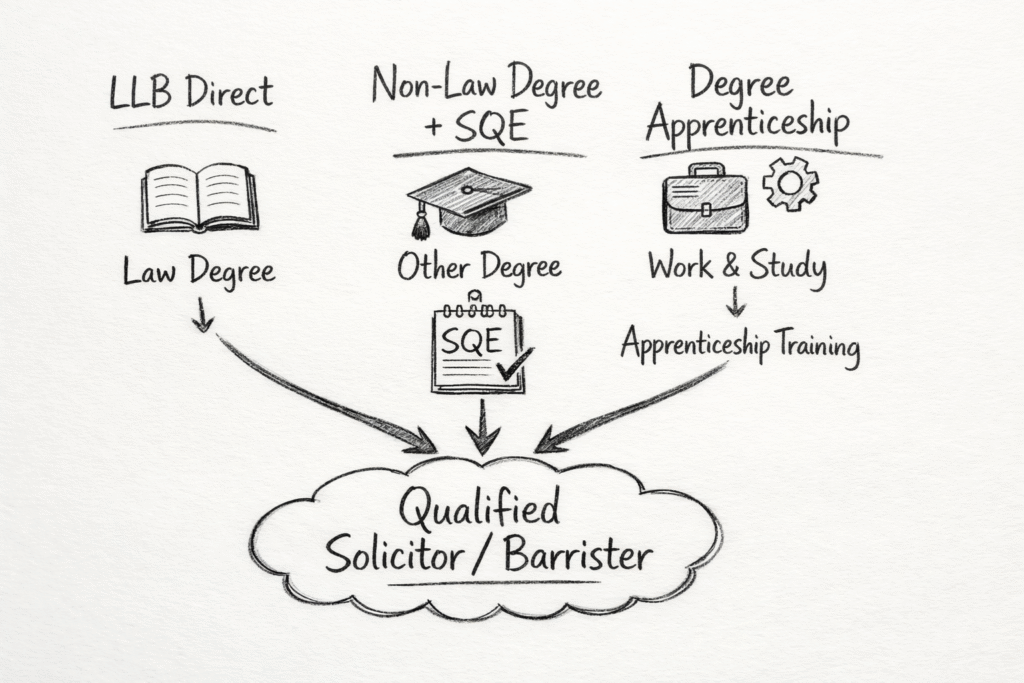
2. Graduate Entry and the SQE Route
If you’ve already got a degree in something else — anything else — you can still qualify as a solicitor without going back to do a full undergraduate law degree. Since 2021, the Solicitors Qualifying Examination (SQE) has replaced the old Graduate Diploma in Law (GDL) as the main conversion route.
This matters enormously. The SQE is a centralised assessment — two stages of exams, plus two years of Qualifying Work Experience (QWE). You don’t need a law degree to sit it, which means the profession is, at least in theory, opening up.
That said, most candidates still take a preparatory course. SQE1 prep courses and the new LLM Qualifying Law programmes (essentially a postgraduate law degree designed for non-law graduates) are growing fast.
3. The Bar Route
Want to be a barrister rather than a solicitor? After your qualifying law degree (or GDL/LLM Qualifying Law), you complete the Bar Practice Course (BPC) — the renamed successor to the Bar Professional Training Course. Then you apply for pupillage, the 12-month traineeship that’s notoriously competitive. Pupillage funded positions at top sets can attract hundreds of applications for single-digit vacancies.
It is, frankly, a brutal funnel. Rewarding, intellectually extraordinary — but brutal.
4. Degree Apprenticeships
Quietly becoming one of the more sensible routes into law. Several large firms now sponsor Solicitor Degree Apprenticeships, where you work and study simultaneously, with the firm covering tuition fees. You earn a wage while getting your degree and QWE simultaneously. The catch? Places are limited and competition is fierce. But for anyone concerned about debt, this is genuinely worth investigating.
The Cost Question (And It’s a Real One)
Let’s be honest about numbers.
| Qualification | Duration | Typical Cost (Home Students) | International Students (Approx.) |
|---|---|---|---|
| LLB (Undergraduate) | 3 years (4 in Scotland) | £9,250/year → ~£27,750 total | £15,000–£25,000/year |
| LLM Qualifying Law (Postgrad) | 1–2 years | £10,000–£18,000 total | £14,000–£22,000 total |
| SQE1 + SQE2 Exams | Ongoing | £4,623 (SQE1) + £2,766 (SQE2) | Same |
| Bar Practice Course (BPC) | 1 year | £13,500–£19,500 | £16,000–£22,000 |
| Solicitor Degree Apprenticeship | 6 years | £0 (employer-funded) | Varies by firm |
Living costs are another matter entirely. London adds a significant premium — expect £1,200–£1,800/month for rent alone in the capital. Cities like Leeds, Sheffield, or Dundee are considerably more manageable. This is worth factoring in when choosing between institutions, not just comparing league table rankings.
For international students specifically: fees at top-tier universities like University College London or King’s College London can push past £35,000/year. It’s a significant investment, and anyone weighing it up seriously should take stock of both scholarship options and the long-term earning potential of the UK legal market.
Which Universities Actually Stand Out?
League tables are useful — but they’re not gospel. The best law school for you depends on what you want to do afterwards.
For commercial and City law: UCL, King’s College London, and LSE are the traditional magnets for corporate firm recruitment. Oxbridge sits above all of them in prestige terms, but their intake is limited and highly selective.
For criminology and public law focus: Keele, Nottingham, and Kent have strong reputations in socio-legal studies and human rights law. Kent in particular has long been associated with the critical legal studies movement — it’s a different flavour of legal education, and deliberately so.
Post-1992 universities are worth taking seriously if entry requirements or cost are a concern. De Montfort, Leeds Beckett, and Northumbria all offer qualifying law degrees with solid professional connections and often more flexible admissions criteria than their Russell Group counterparts.
Scotland deserves its own note entirely. Edinburgh, Glasgow, Aberdeen, and Dundee all offer a four-year LLB — and crucially, it qualifies under Scots law, a distinct legal system from English law. This catches people off guard more often than you’d expect, so if you’re intending to practise in England and Wales, check the qualification requirements before applying north of the border.
One thing worth checking for any university: does the law school have a student law clinic? These are extraordinary learning environments where students handle real cases under supervision. They’re becoming more common, but not universal, and the quality varies considerably.
What You’ll Actually Study (And What Nobody Warns You About)
The first year of an LLB is, for most students, a mild shock. It’s not like A-level law — if you took it. It’s not like Suits or The Good Wife. The early weeks are largely about legal method: how to read a case, how to construct an argument from precedent, how statutes interact with common law.
Contract law tends to be where students either fall in love with legal reasoning or quietly start wondering about changing courses. The logic is intricate. Offer and acceptance, consideration, promissory estoppel — these concepts build on each other in ways that genuinely require re-reading. That’s not a criticism; it’s just honest preparation.
By second year, you’re typically into the specialist areas: land law (surprisingly interesting once you get into adverse possession and easements), equity and trusts (genuinely beautiful as a body of law, if occasionally baffling), and criminal law (where everyone rediscovers their passion for the subject). Mooting — essentially competitive legal argument — usually picks up here, and if you have any courtroom ambitions, getting involved is non-negotiable.
Third year: dissertations, electives, and a growing sense of where you actually want to end up. Human rights law, international law, intellectual property, environmental law — the elective landscape at most institutions is rich, and making considered choices here can shape your applications considerably.
Career Paths After a UK Law Degree
The obvious destinations are solicitor and barrister — but they’re far from the only ones.
| Career Path | Next Step After LLB | Average Starting Salary | Notes |
|---|---|---|---|
| Solicitor (City/Commercial) | SQE + Training Contract | £50,000–£100,000+ | Magic Circle firms start above this range |
| Solicitor (High Street) | SQE + QWE | £25,000–£40,000 | Lower pay; often better work-life balance |
| Barrister | BPC + Pupillage | Varies wildly (£12k–£200k+) | Highly competitive; self-employed in chambers |
| Legal Executive (CILEx) | CILEx qualification | £22,000–£45,000 | Alternative professional route; growing respect |
| In-House Counsel | Qualifying + experience | £40,000–£80,000 | Corporate, tech, media sectors all recruit heavily |
| Legal Journalism / Academia | LLM / PhD / Portfolio | £25,000–£55,000 | Niche but rewarding; strong writing essential |
| Compliance & Regulation | Law degree alone often sufficient | £30,000–£70,000 | Financial services in particular; growing field |
| Government / Civil Service | Fast Stream or direct entry | £28,000–£50,000 | Government Legal Department recruits directly |
What often surprises people: law graduates who don’t practise law tend to do extremely well in fields like finance, management consulting, and tech. The analytical rigour that a law degree UK trains you in is genuinely transferable — employers know this, and they recruit accordingly.
International Students: Specific Considerations
If you’re coming to study a law degree in the UK from overseas, a few things are especially worth knowing.
First, the Student Visa (formerly Tier 4) requires you to have an unconditional offer from a licensed sponsor. Universities handle this routinely, but it requires advance planning — usually 3–6 months before term starts.
Second, if you intend to practise law in your home country after studying in the UK, the qualification may or may not transfer. Some jurisdictions — many Commonwealth countries, parts of the Middle East — have well-established pathways for UK-qualified lawyers. Others require additional examinations. Getting clarity on this before enrolling is something too many students skip.
Third: the UK legal market itself is internationally minded, particularly in London. International commercial law, arbitration, and cross-border corporate work draw talent from across the globe. Speaking additional languages is an advantage that doesn’t get mentioned often enough.
The team at UniStudent Hub works specifically with international students navigating these questions — from understanding entry requirements to working out which UK universities offer the best fit for your circumstances and career goals.
Scholarships and Funding: Less Bleak Than You Think
Home students in England can access the standard student loan system — tuition fees loan plus maintenance loan. The repayment terms have changed in recent years (Plan 5 for new students from 2023), but the core principle remains: you don’t repay until you earn above the threshold.
Scholarships for law students specifically are worth searching actively:
- The Inns of Court (Gray’s Inn, Lincoln’s Inn, Inner Temple, Middle Temple) all offer scholarships and bursaries, primarily for those pursuing the Bar — but some are available to LLB students too. These are not widely advertised; you have to go looking.
- Many universities offer merit scholarships for high-achieving applicants. These are rarely automatic — you often have to apply separately, and deadlines vary.
- For international students, the Chevening Scholarship and Commonwealth Scholarship Commission fund postgraduate study, though competition is intense.
- Several large law firms fund students through their LLB or GDL/LLM via sponsorship schemes tied to vacation scheme and training contract commitments. Clifford Chance and Linklaters are well-known examples.
Worth knowing: Some scholarship schemes for postgraduate law specifically require that you haven’t already received a funded qualification in the UK. Check eligibility criteria carefully — this trips people up.
The Skills That Actually Get You Hired (Law Schools Don’t Say This Enough)
A 2:1 in Law from a decent university used to be sufficient to get you through most interview shortlists. That’s no longer reliably true. What firms and chambers look for now — and this is drawn from actual graduate recruitment feedback — includes:
- Commercial awareness. Understanding how businesses operate, not just how to advise them legally. Reading the FT matters. Understanding deal structures matters.
- Work experience. Vacation schemes, mini-pupillages, legal clinics. The earlier you start, the better your applications.
- Pro bono track record. Increasingly weighted by both corporate firms and public interest employers.
- Demonstrable communication skills — specifically, the ability to explain complex legal concepts clearly to a non-lawyer audience.
One thing that’s genuinely underrated: networking within your law school. Your professors, your visiting lecturers, your mooting partners — these connections matter enormously in a profession that still runs heavily on relationships and reputation.
A Practical Note on Choosing Your University
The decision about where to study your law degree in the UK is partly academic, partly financial, and partly about fit. Don’t underestimate that last one.
Visit if you can. Talk to current students, not just open day ambassadors. Ask specifically about after-degree outcomes — what percentage of law graduates from this institution go on to training contracts or pupillage within two years? Good universities should be able to give you this data; if they’re evasive, that tells you something.
If you’re navigating this from outside the UK — whether from Pakistan, Nigeria, India, Malaysia, or anywhere else — the logistics of university selection, application, and visa processes can feel genuinely overwhelming. This is exactly the kind of situation where good guidance pays for itself. UniStudent Hub offers end-to-end admissions support for students applying to UK universities, including help with personal statements, interview preparation, and financial aid navigation. They’re based at 107 Fleet St, London EC4A 2AB — fittingly, at the heart of legal London — and can be reached on +44 7361 804843.
Their law course listings are worth browsing if you’re still mapping your options.
Frequently Asked Questions
Q: How long is a law degree in the UK? The standard undergraduate LLB is three years in England, Wales, and Northern Ireland. In Scotland, it’s typically four years. Part-time options exist at many universities and can extend this to five or six years.
Q: Can I study law in the UK without A-levels? Yes. Access to Higher Education Diplomas (Access courses) are accepted by many universities. Some institutions also accept BTECs. Foundation year entry routes exist specifically for students who don’t meet standard entry requirements — worth asking about directly.
Q: Is a law degree in the UK worth it? Financially, the answer depends heavily on the route you take and where you end up practising. A career in commercial law in London can be extremely lucrative. A high street practice or public sector role offers a comfortable but not exceptional income. The intellectual rewards are considerable regardless. Law trains you to think — and that, honestly, transfers everywhere.
Q: What grades do I need for a law degree UK? Entry requirements vary widely. The most competitive universities (Oxbridge, UCL, LSE, King’s) typically require A*AA or AAA at A-level, often with a preference for essay-based subjects. Less competitive institutions may accept BBB or lower. UCAS points from BTECs are also accepted at many universities.
Q: Can international students work during their law degree? Yes. Student visa holders are typically permitted to work up to 20 hours per week during term time, and full-time during holidays. Many law students take paralegal positions, which also counts towards qualifying work experience under the SQE framework.
Q: What is the difference between a solicitor and a barrister? Solicitors generally work directly with clients, advising on legal matters and handling transactional work (contracts, conveyancing, wills). Barristers are specialist advocates, primarily instructed by solicitors to represent clients in court. The lines are blurring — solicitors can now apply for Higher Rights of Audience — but the distinction still structures the profession.
Q: Do I need a law degree to become a lawyer in the UK? No — not strictly. The SQE route allows non-law graduates to qualify as solicitors through the new examination and work experience framework. However, a qualifying law degree remains the most common and often the most efficient path.
Closing Thoughts
A law degree UK remains one of the more demanding, more intellectually rich, and — for the right person — more rewarding routes through higher education. The system is genuinely complex, though. The routes in are multiplying, the costs are real, and the gap between qualifying academically and qualifying professionally is one that catches people off guard.
If there’s one thing to take from all of this: do your research early, understand what you’re working towards, and don’t underestimate the value of good guidance. The right advice — whether on university selection, scholarship applications, or visa processes — can meaningfully change outcomes.
For more information about studying law and other courses in the UK, visit the UniStudent Hub blog or explore their study in the UK guidance pages.