
So you want to become a nurse in Britain — and you’d really rather not spend the next decade drowning in debt while doing it. That’s not just reasonable. It’s actually quite achievable, and far more so than most people realise when they first start Googling at midnight, slightly panicked, wondering if they’ve missed something.
The good news: the UK has one of the most generous nursing funding landscapes in the world right now. The slightly frustrating news: it’s spread across about six different systems, each with its own eligibility rules, deadlines, and acronyms. NHS Learning Support Fund. Student Finance England. NHS Bursaries (Scotland’s version is different to Wales’s, which is different again to Northern Ireland’s). It can feel like doing a jigsaw where someone’s hidden half the pieces.
This guide pulls it all together. Whether you’re a school leaver eyeing your first degree, a healthcare assistant looking to top up, or an international student wondering what — if anything — applies to you, there’s something useful here. Let’s get into it.
What “Free” Actually Means for Nursing Students in the UK
Before anything else, a quick reality check. When people talk about how to study nursing in UK for free, they’re usually referring to a combination of:
- Non-repayable grants that never need paying back
- NHS-funded bursaries that cover tuition and sometimes living costs
- Scholarships from universities, charities, or NHS trusts
- Loan repayment schemes where your employer eventually clears your debt
None of these, individually, will necessarily cover everything. But stack two or three together? You’re looking at a genuinely low-cost — sometimes truly free — nursing education.
The situation in 2024–25 is arguably better than it’s been since 2017, when the old NHS bursary system was scrapped (briefly, badly, and expensively for students). Several funding streams have since been restored or expanded. So if you looked into this a few years ago and walked away discouraged, it’s worth a fresh look.
The NHS Learning Support Fund — The Big One
If you’re studying nursing in England, this is the funding stream you absolutely must know about.

The NHS Learning Support Fund (LSF) provides non-repayable grants to eligible nursing, midwifery, and allied health profession students. As of 2024–25, eligible students can receive:
- A Training Grant of £5,000 per year — paid automatically, no means-testing required
- An additional £3,000 Specialist Subject Payment for mental health and learning disability nursing students
- A Parent’s Learning Allowance of up to £2,000 for students with dependent children
- A Childcare allowance of up to £1,000 per child per year
That training grant alone is significant. It doesn’t touch your student loan entitlement either — you can receive both simultaneously. The NHS LSF is administered through NHS Business Services Authority (NHSBSA), and applications open each academic year.
Worth noting: The £5,000 training grant was introduced in 2020 and has been confirmed for continuation. But policy can shift — always check the NHSBSA website for the most current figures before applying.
Student Loans Still Apply (and That’s Not Nothing)
Here’s something that surprises people: nursing students in England are entitled to the same Student Finance package as any other undergraduate. That means:
- Tuition Fee Loan up to £9,250 per year (covers your entire tuition at most universities)
- Maintenance Loan for living costs — amount depends on household income and where you study
The Tuition Fee Loan doesn’t touch your bank account — it goes directly to your university. You only repay once you’re earning over the threshold (currently £25,000), and only 9% of anything above that. If you work in the NHS long-term and your salary remains modest, there’s a reasonable chance a significant portion of this gets written off after 40 years anyway.
So the practical cost of tuition? For most UK nursing students: zero, upfront.
Scotland, Wales, Northern Ireland — Different Rules, Often Better Ones
| Nation | Tuition Fees | Bursary / Grant | Key Notes |
|---|---|---|---|
| Scotland | Free for Scottish-domiciled students | Bursary up to £10,000/yr (income-assessed) | NHS Education for Scotland (NES) administers funding. Exceptionally generous for residents. |
| Wales | Covered by NHS Wales bursary | NHS Wales Bursary — tuition + maintenance support | NHS Wales covers tuition fees directly. Means-tested maintenance grant also available. |
| Northern Ireland | £4,715/yr (lower than England) | NHS bursary covers tuition; maintenance bursary available | Department of Health NI administers. Students still eligible for student loans top-up. |
| England | Up to £9,250/yr (loan-funded) | £5,000 non-repayable grant (LSF) + loan | Most students combine LSF grant + Tuition Fee Loan + Maintenance Loan. |
Scotland, in particular, deserves a moment. If you’re domiciled in Scotland and study at a Scottish university, your tuition is covered entirely by the Student Awards Agency Scotland (SAAS). Add the NES bursary, and nursing in Scotland can be genuinely, substantively free — arguably the most complete funding package in the UK for healthcare students.
University Scholarships Worth Actually Applying For
Universities don’t shout about these loudly enough, honestly. Scattered across almost every UK institution offering nursing programmes are scholarships that go underclaimed every year because students assume they won’t qualify or don’t know to look.
A few examples worth exploring:
King’s College London — offers several healthcare bursaries and has NHS partnership funding for students on placement at Guy’s, King’s and St Thomas’ NHS Foundation Trust.
University of Manchester — the Manchester Nursing and Midwifery Bursary provides support for students from widening participation backgrounds.
Teesside University — runs placement support schemes and has strong NHS North East partnership arrangements. If you’re considering the north of England for your nursing degree, Teesside is worth a close look.
University of Sunderland — has a history of supporting mature students into nursing and healthcare, with dedicated financial guidance. Their nursing programmes and funding support are particularly accessible for career changers.
Leeds-based institutions — the University of Leeds has links with Leeds Teaching Hospitals Trust and various bursary pathways for students going into NHS-facing careers.
The honest advice here: contact the financial aid office directly at any university you’re applying to. Not the admissions page. The actual financial aid team. Ask them point-blank what’s available for nursing students from your background. The answers are frequently more interesting than anything listed on the website.
Charitable Scholarships — The Underused Category
This is where it gets genuinely interesting, and where most students leave money on the table.
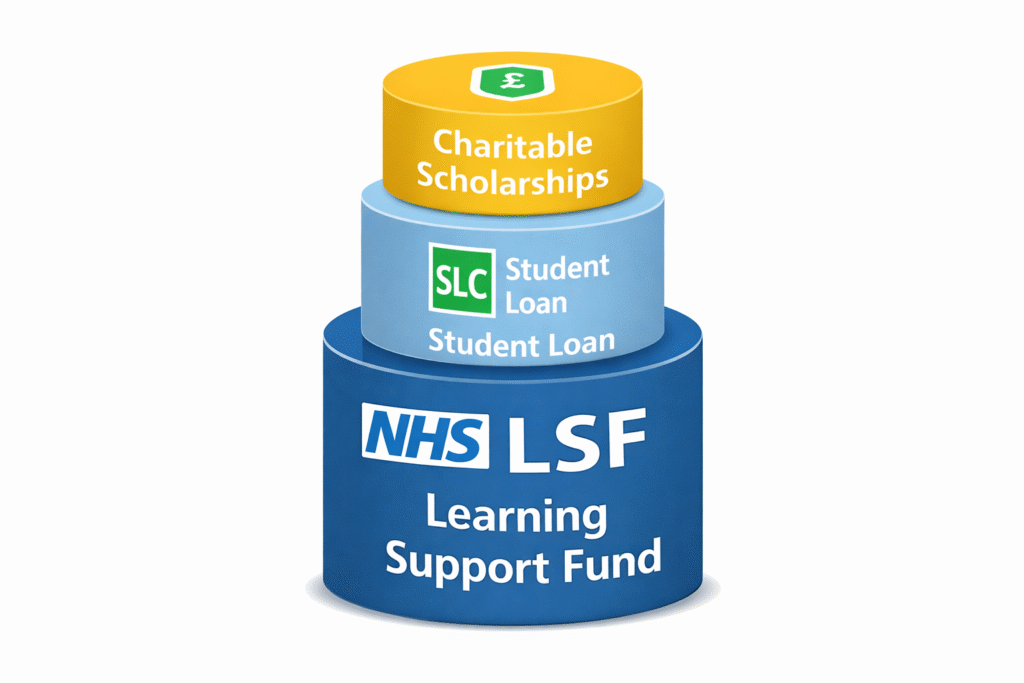
Dozens of nursing-specific and healthcare-adjacent charities offer scholarships, bursaries, and grants. They vary hugely — some are £500 one-off awards, others cover an entire year of living costs. The Royal College of Nursing (RCN) Foundation, for instance, administers grants for nursing students experiencing financial hardship. The Florence Nightingale Foundation offers scholarships for post-registration development.
A non-exhaustive hit list to research:
- RCN Foundation — hardship grants and educational bursaries for nursing students
- Burdett Trust for Nursing — primarily for post-registration, but worth watching
- The Hospital Saturday Fund — medical education bursaries open to student nurses
- The Florence Nightingale Foundation — development scholarships (mostly post-qualification but worth knowing for the future)
- The Windle Trust International — for international nursing students, specifically from lower-income countries
- NHS Charities Together — various local NHS charity arms offer student support
The Royal College of Nursing is your best first stop. Their financial support page is updated regularly and links to dozens of external grants you’d never stumble on through a casual search.
NHS Sponsorship and Earn-While-You-Learn Routes
Not everyone has to study full-time as a traditional student. There’s a growing — and underappreciated — route into nursing that involves being employed by an NHS trust while you train.
NHS-sponsored nursing apprenticeships (specifically the Nursing Degree Apprenticeship) allow you to earn a salary, receive full training, and come out the other end with a registered nursing qualification, with your training costs covered by the Apprenticeship Levy. No tuition fees. No student loan debt. An actual salary throughout.
Availability varies by trust and region — you’d apply directly to NHS trusts rather than through UCAS — but the NHS Jobs website lists live apprenticeship vacancies. Competition is stiff in some areas, but the model is expanding significantly.
There’s also the Return to Practice scheme for nurses who trained previously and let their registration lapse — often fully funded by local NHS systems and worth knowing about if that applies to you or someone you know.
What International Students Need to Know
Honest moment: if you’re an international student (non-EU/EEA, post-Brexit), fully free nursing study in the UK is harder to achieve. The NHS LSF, student loans, and most domestic bursaries require you to be settled or pre-settled in the UK, or to have been resident for a certain period.
That said, several options still exist:
Chevening Scholarships — primarily for postgraduate study, but covers nursing at master’s level for students from eligible countries. Fully funded, including flights and living costs.
Commonwealth Scholarships — similar scope, covering students from Commonwealth nations. Check the Commonwealth Scholarship Commission for nursing-adjacent eligibility.
University merit scholarships — many UK universities offer international student scholarships of £2,000–£8,000 off tuition, specifically for high-achieving applicants. These don’t make nursing free, but they make it meaningfully cheaper.
NHS Overseas Recruitment — somewhat different to studying, but international nurses can come to the UK on a Health and Care Visa, with some trusts covering visa costs and offering relocation packages. It’s not a scholarship route, but it is a funded pathway into UK nursing.
If you’re an international student navigating all this from outside the UK, it’s genuinely worth speaking to an education consultant who knows the current visa landscape. The team at UniStudent Hub (based at 107 Fleet St, London EC4A 2AB, reachable on +44 7361 804843) works specifically with international students pursuing UK healthcare and other programmes — their scholarship and financial aid advisory service is particularly useful if you’re trying to piece together funding from multiple sources.
A Closer Look at Nursing Specialisms and Their Funding Differences
| Nursing Specialism | Standard LSF Grant | Specialist Top-Up | Example University |
|---|---|---|---|
| Adult Nursing | £5,000/yr | — | University of Sunderland, Teesside |
| Mental Health Nursing | £5,000/yr | +£3,000 Specialist Payment | Leeds, Manchester |
| Children’s Nursing | £5,000/yr | — | Various |
| Adult Mental Health Nursing | £5,000/yr | +£3,000 Specialist Payment | University of Leeds, Bradford |
| Learning Disability Nursing | £5,000/yr | +£3,000 Specialist Payment | Various |
(Note: the £3,000 specialist top-up applies only in England via the LSF. Scotland, Wales and NI have separate arrangements — confirm directly with your funding body.)
Mental health and learning disability nursing both attract the specialist supplement because of chronic workforce shortages. If you’re weighing up specialisms and finances matter to you — and they do, that’s not shallow, that’s practical — choosing one of these routes in England adds £3,000 per year to your non-repayable grant. That’s real money.
There’s a fuller breakdown of nursing entry requirements and specialism pathways on the UniStudent Hub nursing entry requirements page — useful reading before you commit to an application route.
The Placement Problem Nobody Warns You About
One thing that often catches nursing students off guard: the cost of placements.
NHS nursing degrees require significant clinical placement hours — often 2,300 hours across a three-year programme. These placements take you out of your home area, create travel costs, sometimes require accommodation. Student loans and grants are calculated on your academic life, not your placement life.
The NHS LSF does include a Travel and Dual Accommodation Expenses (TDAE) claim mechanism for placement-related costs. You can claim back:
- Excess travel costs (beyond your normal commute to university)
- Accommodation costs if your placement requires you to stay away from home
- Certain childcare costs during placement hours
This is claimed through the NHSBSA portal and many students don’t realise they’re entitled to it. Keep your receipts. Keep all of your receipts.
Nurse Top-Up Degrees and Continuing Education Funding
Already working in healthcare and looking to convert or top up? The funding picture is slightly different for you — and in some ways, more flexible.
Nursing Associate to Registered Nurse top-up degrees are increasingly NHS-funded, with many trusts sponsoring their nursing associates through the top-up pathway. If you’re currently working as a healthcare assistant or nursing associate, talk to your NHS trust’s workforce development team. They may fund your degree in exchange for a commitment to continue working for them post-qualification.
The nursing top-up degree pathway is available at several UK universities and is increasingly integrated with NHS workforce planning rather than sitting outside it.
Frequently Asked Questions
Can I study nursing in the UK for free as a UK student? Yes — combining the NHS Learning Support Fund grant (£5,000/yr in England, paid directly to you), a Tuition Fee Loan (which only requires repayment above a salary threshold), and potentially university or charitable scholarships, many UK students complete nursing degrees at minimal or zero upfront cost.
Does the NHS pay for nursing degrees? Not entirely and not directly — but the NHS Learning Support Fund provides a non-repayable £5,000 annual training grant to eligible students in England. Scotland and Wales have separate NHS bursary systems that can cover tuition fees for eligible students.
Are there fully funded nursing scholarships in the UK? Genuinely full funding (covering both tuition and living costs) is most achievable through the NHS Nursing Degree Apprenticeship route, or for Scottish-domiciled students studying in Scotland. Charitable scholarships can add meaningful top-ups but rarely cover everything alone.
Can international students study nursing in the UK for free? Domestic funding (NHS LSF, student loans) is not available to most international students. However, Chevening and Commonwealth Scholarships cover nursing at postgraduate level, and many universities offer partial merit scholarships. International nurses may also come via NHS overseas recruitment with some costs covered by trusts.
What is the NHS Learning Support Fund? The NHS LSF is a package of non-repayable financial support for nursing, midwifery and allied health students in England. It includes a £5,000 annual training grant, specialist subject supplements, and allowances for parents and childcare costs. Applications are made through the NHSBSA.
Can I work while studying nursing in the UK? Yes, though clinical placement hours are demanding. Many nursing students work part-time in healthcare roles (which can complement their studies). Hours during placement periods are restricted, but term-time and summer working is common.
How long does it take to qualify as a nurse in the UK? Standard pre-registration nursing degrees take three years full-time. Nursing degree apprenticeships take the same duration but include employment throughout. Some accelerated programmes exist for graduates with relevant degrees.
Putting It All Together
Studying nursing in UK for free — or close to it — isn’t a fantasy. It requires knowing which funding streams apply to your situation, applying for everything you’re eligible for (not just the obvious ones), and being willing to do a bit of paperwork. Not glamorous. But worth it.
The landscape looks like this in summary:
- England: NHS LSF grant (£5,000/yr, non-repayable) + Tuition Fee Loan + potential charitable scholarships
- Scotland: Tuition free for Scottish students + NES bursary — genuinely the best deal in the UK
- Wales & Northern Ireland: NHS bursaries covering tuition with maintenance support
- All nations: Charitable scholarships, NHS apprenticeship routes, placement cost reimbursement
If you’re at the early stages of researching nursing degrees in the UK and feeling slightly overwhelmed by the options, that’s completely normal. The UniStudent Hub team offers end-to-end admissions support specifically for students navigating UK university applications — including scholarship and financial aid advisory — and can help you work out what’s actually available for your specific circumstances before you commit to anything.
You can also explore specific programmes including adult nursing, mental health nursing, and public health degrees across UK universities via their course listings.
Nursing in the UK is one of the most financially supported degree routes available right now. The system isn’t perfect — no system involving this many acronyms ever is — but if you know where to look, you can study nursing in UK for free, or as close to it as makes very little practical difference.