
There’s a very specific kind of panic that hits around week three of MBA research. You’ve opened nineteen browser tabs, three of them are league tables that disagree with each other, and somewhere in the chaos you’ve started wondering whether any of this actually leads to a job. Fair question. A brutally fair one, actually.
Here’s the uncomfortable truth nobody puts in the prospectus: not all MBA courses in UK business schools deliver the same outcome. Two graduates can leave with the same three letters after their name and walk into completely different futures — one into a consulting offer worth six figures, the other into a job hunt that drags on for eight months. The difference usually isn’t intelligence or effort. It’s which building they sat in, what network they had access to, and whether the careers team actually picked up the phone when it mattered. At Uni Student HUB, we spend a fair amount of our week untangling exactly this — helping applicants work out which MBA courses in UK universities genuinely translate into employment, rather than just a nice certificate for the wall.
So let’s get into it properly.
The Employability Question Nobody Asks Early Enough
Most people start their search with rankings. Understandable — rankings are tidy, numeric, reassuring. But rankings measure a blend of things (research output, faculty diversity, alumni salary averages, sometimes even how many staff hold doctorates) that don’t always translate into “will I have a job by September.”
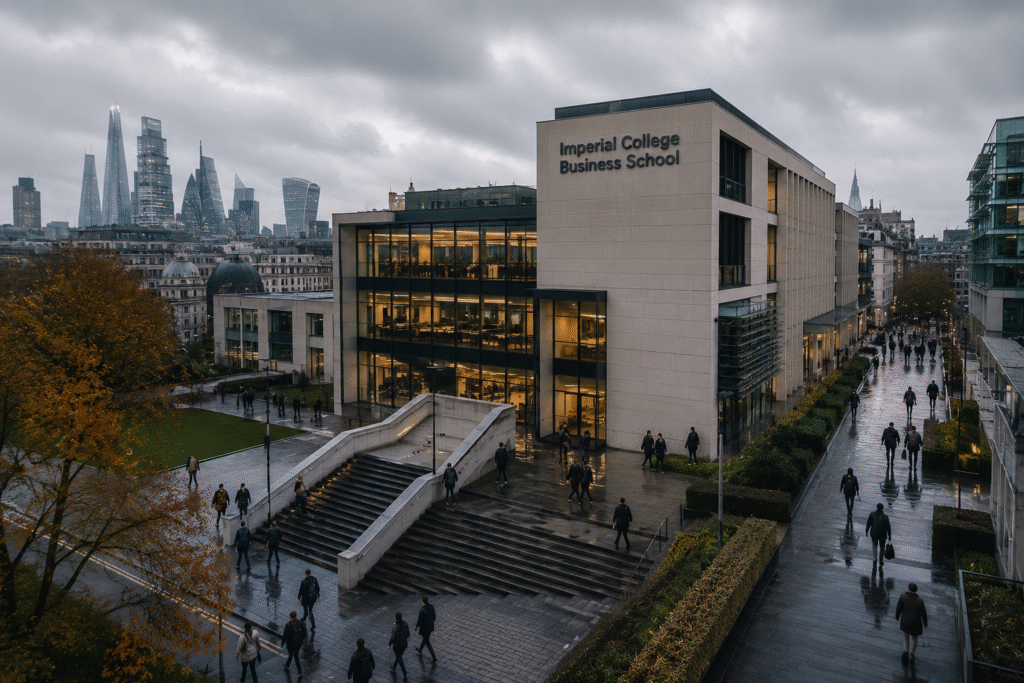
What actually predicts employability for MBA courses in UK institutions is narrower than a league table suggests:
- Employer relationships that are active, not historical. A school that mentions Goldman Sachs once in 1998 is not the same as one running live recruiting events every term.
- Career services staff-to-student ratios. Some schools have dedicated one-to-one coaching; others hand you a PDF and a Slack channel.
- Cohort size and sector concentration. Smaller, focused cohorts (think Bayes for finance, Imperial for tech) often punch above their weight precisely because recruiters know exactly what they’re getting.
- Location. London-based schools have an obvious edge for finance and consulting recruiting simply through proximity — quicker for a hiring manager to pop in for a panel than fly up from the capital.
None of this shows up cleanly on a spreadsheet, which is exactly why so many applicants get blindsided.
What UK MBA Programmes Actually Look Like Day to Day
Structurally, MBA courses in UK universities tend to follow a fairly consistent shape, even if the branding differs wildly:
- Full-time, one year. The default format, and genuinely one of the UK’s biggest selling points against two-year US programmes — less tuition, less lost income, faster return to the workforce.
- Executive MBA, 20–28 months, part-time. Built for people who aren’t quitting their job to study; weekend and block-release teaching.
- Online or blended MBA. Increasingly common, increasingly respected, and considerably cheaper — Bradford’s online MBA, for instance, runs at roughly a third of the cost of comparably ranked on-campus programmes.
Core modules are broadly similar everywhere — strategy, finance, operations, leadership, marketing — but the electives are where schools differentiate. Warwick leans into supply chain and analytics. Bath has built a genuine reputation around sustainability-focused business education. Imperial folds in AI and STEM-adjacent modules because, well, it’s Imperial. Durham has quietly built strong consulting placement pipelines. If your career goal is specific, the elective list matters more than the crest on the building.
The Numbers Bit (Handle With Care)
Fees for MBA courses in UK universities range enormously — from roughly £7,000 at smaller, university-affiliated colleges up past £115,000 at London Business School. That’s not a typo. It’s also not the whole story, because a cheaper course with a weak careers office can end up costing more in lost time and opportunity than an expensive one that gets you hired in eight weeks.
| University | Full-Time MBA Fee (approx.) | Employment Rate (3–6 months) | Average Post-MBA Salary |
|---|---|---|---|
| London Business School | £115,950 | 95% | £100,000+ (rising sharply by year 3) |
| Warwick Business School | £59,500 | 89% | £98,487 |
| Cranfield School of Management | £47,335 | 90%+ | £75,833 |
| University of Edinburgh Business School | £43,300 | 91% | £75,635 |
| Imperial College Business School | £64,000 | 91% | Strong, tech-sector skewed |
| Bayes Business School (City, London) | £42,000 | 92% | £82,000 |
| Alliance Manchester Business School | £28,000 | Solid, regionally strong | ~40% salary increase |
Figures compiled from published 2026 school data and third-party MBA ranking reporting; always check the current fee schedule directly with the school before applying, since these numbers shift year on year.
Now, the deliberately rougher one — because real budgeting rarely lines up as neatly as a marketing table pretends it does:
| Cost item | Low end | Typical | Notes |
|---|---|---|---|
| Tuition | £7,000 | £25,000 – £45,000 | |
| London living costs (per year) | £15,000 | higher if central | |
| GMAT / test prep | £150 | £1,500 (with tutoring) | |
| Visa + healthcare surcharge | roughly £2,000–£3,000 total | changes with policy — check gov.uk before budgeting | |
| Consultancy / admissions support (optional) | Free (some guidance) | Varies by service | |
(Yes, that table’s a bit untidy — deliberately so. Real MBA budgeting rarely arrives in clean rows either.)
Accreditation: The Alphabet Soup That Actually Matters
Somewhere in your research you’ll bump into AACSB, AMBA, and EQUIS. Ignore them at your peril. These three bodies independently audit business schools, and a school holding all three — known as the “triple crown” — is a genuine, meaningful quality signal, not just a badge for the website footer. Fewer than 1% of business schools worldwide hold all three simultaneously. Warwick, Cranfield, Bath and a handful of others in the UK carry this distinction. You can check current status directly via AACSB, AMBA, or EFMD/EQUIS rather than trusting a marketing page.
Quick gut-check: if a course can’t tell you clearly which of the three accreditations it holds — not “we’re accredited,” but which specific bodies — treat that as a small red flag, not a technicality.
Career Services: The Bit That Actually Wins or Loses the Whole Bet
I’ll be blunt. This is the section most applicants skim past, and it’s the one that predicts outcomes best. A school with an average ranking but an aggressive, well-connected careers team will often out-place a “prestigious” school running a skeleton careers office. Ask pointed questions before applying:
- How many dedicated one-to-one coaching hours are built into the programme?
- Which employers ran on-campus recruiting last term — not five years ago, last term?
- What’s the median time-to-offer for international graduates specifically (this differs meaningfully from the domestic figure)?
- Is there a formal alumni mentoring structure, or is “alumni network” just a LinkedIn group nobody checks?
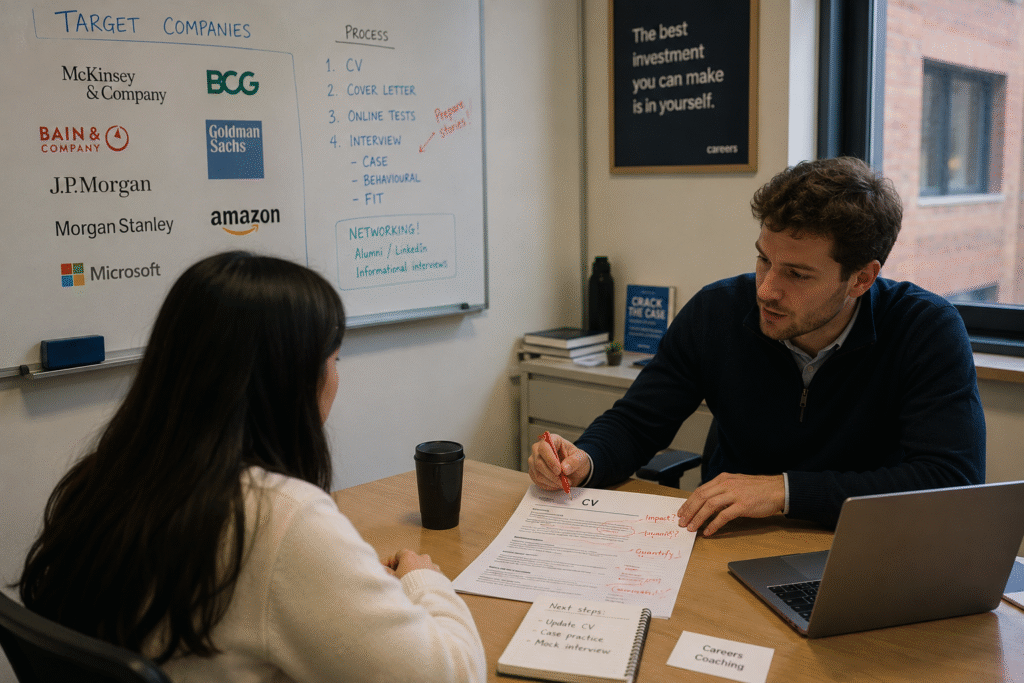
If you’re weighing multiple MBA courses in UK universities and can’t get straight answers to these, that itself tells you something.
The International Student Layer
For students coming from outside the UK, an MBA sits inside a bigger decision — visas, work rights, cost of living, and long-term settlement plans all stack on top of the academic choice. The Graduate Route visa currently allows two years of post-study work in the UK after most master’s degrees, which meaningfully changes the calculus versus, say, a US MBA with a tighter and more competitive OPT window. Details and eligibility do shift with policy, so it’s worth checking the official Graduate visa guidance on gov.uk directly rather than relying on secondhand summaries (including this one).
This is genuinely where a lot of applicants stall — not because the coursework is intimidating, but because navigating admissions timelines, GMAT waivers, scholarship deadlines and visa documentation simultaneously is a logistics problem as much as an academic one. It’s the exact gap Uni Student HUB tends to get pulled into: end-to-end admissions support, interview and admission preparation, scholarship and financial aid advisory, and pre-departure orientation once an offer’s actually in hand. None of that changes which school is “best” for you — but it does stop good candidates losing offers over paperwork, which happens more often than people admit.
If you’re earlier in the process and still comparing postgraduate courses more broadly — not just MBAs — it’s worth reading our related piece on the insider’s guide to UK master’s programmes before narrowing down.
Comparing MBA in the UK vs. Related Business Master’s Routes
Not everyone actually needs a full MBA. If you’re under 27 or have limited management experience, admissions panels increasingly nudge candidates toward a specialised master’s instead — a Business Management, Business Administration, Finance and Accounting, or Human Resource Management route, for example. MBAs are, at their core, designed for people with a few years of work experience under their belt already — the classroom discussions genuinely lean on that experience. Walking in without it can leave you underwhelmed by a programme built around peer war-stories you don’t yet have.
Regional Alternatives Worth a Proper Look
London dominates the conversation, understandably, but it isn’t the only sensible answer. Business schools tied to universities like Strathclyde in Glasgow, Sheffield, Surrey, and Durham offer meaningfully lower living costs, smaller cohorts, and — in several cases — stronger regional employer ties than their brand recognition suggests. If your goal is a UK career outside the London finance-and-consulting bubble, these are worth weighing properly rather than dismissing on reputation alone. You can browse the full spread of partner universities to compare.
Frequently Asked Questions
Is an MBA from the UK respected internationally? Yes — UK business degrees carry strong global recognition, particularly triple-accredited schools, and UK MBA graduates are represented across major global employers in finance, consulting and tech.
How long do MBA courses in UK universities typically take? Most full-time programmes run for one year, considerably shorter than the standard two-year US format. Executive and online routes stretch to 20–28 months part-time.
Do I need a GMAT score to apply for MBA courses in UK institutions? Often yes, though requirements vary and many schools offer waivers based on significant work experience. A competitive score for top-tier schools tends to sit around 600–700+.
Are scholarships available for international MBA students? Yes — many UK business schools run merit-based, leadership, and programme-specific scholarships, and some students are eligible for external funding such as Chevening.
Can I work in the UK after finishing my MBA? Under the current Graduate Route, most master’s graduates (MBA included) can apply to stay and work in the UK for two years post-study. Always confirm current eligibility on gov.uk before assuming this applies to your situation.
Making the Actual Decision
If there’s one thing worth carrying out of this whole comparison exercise, it’s this: stop asking “which is the best university” and start asking “best for what.” Best for a consulting career? Best for a modest budget and a realistic ROI? Best for staying in the UK long-term versus building a global CV? MBA courses in UK business schools each answer a slightly different question, and the mismatch between applicant goals and school strengths is honestly the single biggest cause of MBA regret I’ve come across.
If you’d rather not untangle this alone — the GMAT waivers, the accreditation checking, the scholarship deadlines that all seem to land in the same fortnight — Uni Student HUB can walk through university admissions, interview preparation, and financial aid advisory with you directly. Reach the team on +44 7361 804843, or drop by the office at 107 Fleet St, London EC4A 2AB. Sometimes the most useful next step isn’t more research; it’s a fifteen-minute conversation with someone who’s seen the process from the inside.