
Aberdeen doesn’t always make the headline lists. It’s not London. It’s not Edinburgh with its festival glow or its overpriced flat shares. But there’s something quietly remarkable happening in this granite city on Scotland’s north-east coast — a concentration of serious academic talent, surprisingly affordable living, and a student culture that’s neither too intense nor too sleepy. If you’re weighing up where to study in the UK, the universities in Aberdeen deserve a far more honest look than most guides offer.
This isn’t going to be a press-release rundown. Let’s actually talk about what’s on offer — courses, realistic costs, how day-to-day life holds up, and where to go if you need proper guidance navigating the applications maze.
The Two Giants: Aberdeen’s Main Universities
There are two principal universities in Aberdeen that most prospective students are choosing between. They’re quite different beasts, and conflating them is a common mistake.
University of Aberdeen — The Ancient One
Founded in 1495, the University of Aberdeen is the fifth-oldest university in the UK. That’s not just trivia for your pub quiz. It means deep-rooted academic traditions, a sprawling medieval campus at Old Aberdeen, and an international reputation that carries real weight in fields like medicine, law, divinity, and petroleum engineering.
The King’s College campus is genuinely beautiful in the way that only very old things can be — all sandstone and carved archways, with a crown tower that somehow manages to look both austere and theatrical. Worth a visit even if you’re not applying.
Popular undergraduate courses include:
- Medicine (MBChB) — intensely competitive, requires strong A-levels or Highers and UCAT
- Law (LLB) — Scottish law programme, recognised across jurisdictions
- Business Management — broad, with strong links to Aberdeen’s energy industry
- Computer Science — growing considerably, with industry placement options
- Marine Biology — makes peculiar sense when you’re twenty minutes from the North Sea
Postgraduate programmes span an enormous range. The MSc in Oil and Gas Studies is arguably one of the most job-specific master’s degrees in the country — Aberdeen is, after all, Europe’s energy capital, a title it guards jealously. There are strong research programmes in environmental science, healthcare, and artificial intelligence too.
Tuition Fees (2024–25 approximate):
| Student Type | Undergraduate (per year) | Postgraduate (per year) |
|---|---|---|
| Scottish Domiciled | Free (SAAS funded) | £7,500–£10,000 |
| Rest of UK (RUK) | £9,250 | £9,000–£13,000 |
| International Students | £19,800–£36,400 | £18,500–£28,000 |
Note: Medical and clinical courses sit at the higher end. Always verify directly with the university — fees shift.
Robert Gordon University (RGU) — The Practical Powerhouse
RGU doesn’t pretend to be something it isn’t. It’s a modern university with a no-nonsense focus on graduate employability, and by most measures, it delivers. Consistently ranking among the top UK universities for graduate outcomes, RGU has built its reputation on courses that are stitched tightly to industry.
Its Garthdee campus sits on the south side of Aberdeen along the River Dee — modern, purpose-built, with facilities that feel genuinely current rather than architecturally apologetic. The library alone is worth a mention: it’s open late, well-resourced, and actually pleasant to sit in, which is rarer than it should be.
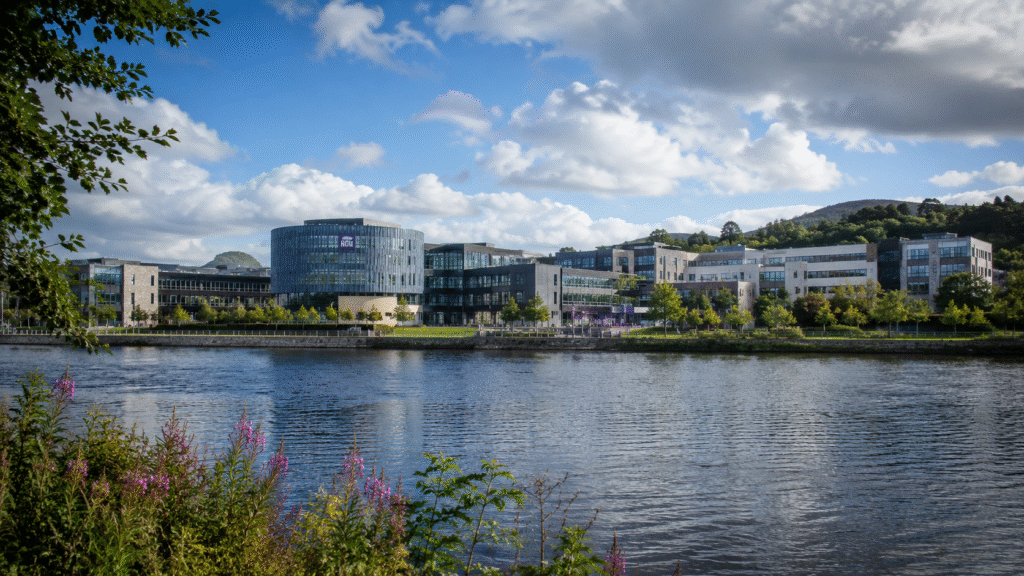
Courses that stand out at RGU:
- Nursing and Midwifery — long track record, strong NHS Scotland placements
- Architecture — professionally accredited, small cohorts
- Pharmacy (MPharm) — one of the few pharmacy programmes in Scotland
- Gray’s School of Art — yes, this is part of RGU, and it punches well above its weight nationally
- Oil and Gas Engineering / Subsea Engineering — industry co-designed programmes
Honestly, if you’re a student who learns best through placement years, industry projects, and applied briefs rather than purely academic seminars, RGU might suit you better than the older university, whatever the league tables imply.
Approximate Fees at RGU:
| Student Category | UG Annual Fee | PG Annual Fee | Notes |
|---|---|---|---|
| Scottish Domiciled | Free (SAAS) | £6,500–£9,000 | Eligibility criteria apply |
| Rest of UK | £9,250 | £8,500–£12,000 | |
| International | £15,000–£22,000 | £14,000–£20,000 | Varies by programme significantly |
Entry Requirements: What You’re Actually Looking At
The gap between published entry requirements and reality is worth flagging. Both universities in Aberdeen list minimum entry points, but competition fluctuates year to year.
University of Aberdeen typically asks for:
- A-levels: ABB to AAA depending on programme (Medicine: typically AAA + UCAT)
- Scottish Highers: BBBB to AAAB
- International Baccalaureate: 32–38 points
- English language: IELTS 6.0–7.0 (varies by faculty)
RGU tends to be slightly more accessible at entry:
- A-levels: CCC to ABB
- Scottish Highers: BCCC to ABBB
- Foundation/access routes: Available for most faculties
- IELTS: 6.0 overall (most programmes)
Both universities accept a range of international qualifications. If you’re coming from outside the UK and unsure whether your qualifications translate directly, that’s exactly the kind of thing an education consultant can untangle quickly — the team at Uni Student HUB in London has done this for students from dozens of countries and will tell you plainly whether your grades are competitive before you spend months on an application that was never going to fly.
Scholarships That Actually Exist (Not Just the Ones Everyone Lists)
Scottish universities have a reputation for being generous with funding, and it’s not entirely undeserved.
University of Aberdeen offers:
- Aberdeen Global Scholarship — up to £6,000 for international undergraduates
- Elphinstone Scholarship — for high-achieving international postgraduate students
- Subject-specific bursaries through departments (medicine, law, and engineering tend to have their own pots)
RGU offers:
- International Excellence Award — automatic fee reduction for qualifying international students
- Gray’s School of Art Scholarship — for creative arts postgraduate students
- Energy sector-specific scholarships in partnership with industry
Also worth investigating: the Scottish Government’s Saltire Scholarships (for students from Canada, China, India, Japan, Pakistan, and USA), and GREAT Scholarships for students from certain countries through the British Council. These are chronically under-applied for. The British Council’s scholarship finder is a good place to start.
Aberdeen as a Student City — The Unvarnished Version
Here’s the thing about Aberdeen that university brochures skip over: it is not a warm city in any meteorological sense. Winds off the North Sea in January are a character-building experience. Pack accordingly and make peace with it early.

But once you’re past the weather, Aberdeen is genuinely excellent for students.
Cost of living is meaningfully lower than Edinburgh, Glasgow, and obviously London. A decent room in a shared house runs around £450–£600/month in most areas students actually want to live. Groceries are manageable. Nights out needn’t be ruinous.
Transport: Aberdeen has a city bus network that works, and both main university campuses are well-connected. A bike helps for Old Aberdeen in particular — the university area is flat enough to be pleasant.
Student social life revolves around the Student Union buildings at both institutions. The Uni of Aberdeen’s Students’ Association on University Road is a proper venue; RGU’s student union at Garthdee has grown considerably. Beyond that, Aberdeen has a craft beer scene that’s taken off, a respectable music venue in the Lemon Tree, and more independent coffee shops than you’d expect for a city its size.
Culturally, the city leans into its North Sea oil heritage — which sounds uninspiring until you realise this means Aberdeen has had serious international money passing through it for fifty years, producing a food scene, arts infrastructure, and a confidence that smaller cities sometimes lack. The Aberdeen Art Gallery, after its recent renovation, is genuinely world-class.
For International Students: What Aberdeen Specifically Offers
Both universities in Aberdeen have invested heavily in international student infrastructure. This isn’t just about English language support (though both offer pre-sessional English programmes — worth asking about if your academic English needs polishing).
The University of Aberdeen’s International Study Centre runs foundation and pre-master’s programmes specifically designed as a bridge into degree-level study. RGU has similar provision through its international partnerships.
Both universities offer dedicated arrival support, airport transfers, and orientation weeks. Aberdeen airport has direct connections to London, Amsterdam, and several other European cities, which matters more than it sounds when you’re navigating the first few weeks of life in a new country.
A point worth making clearly: visa compliance is non-negotiable, and the UK’s student visa requirements have grown more stringent. If you’re coming from outside the UK, get proper guidance before you apply — not after. Services like those offered by Uni Student HUB include end-to-end admissions support and pre-departure orientation, which takes some of the anxiety out of a process that can otherwise feel like navigating a bureaucratic labyrinth while blindfolded.
Postgraduate Study in Aberdeen: A Quick Word
Aberdeen is genuinely well-suited for postgraduate study, partly because of the energy sector connections (oil, gas, renewable energy, subsea technology — all clustered here) and partly because postgraduate cohorts at both universities tend to be international and diverse in ways that enrich the experience.
If you’re considering a UK Master’s programme, Aberdeen offers some distinct advantages: lower fees than the London average, smaller class sizes than the Russell Group giants, and sector-specific programmes in energy, health, and creative industries that you won’t easily find elsewhere in quite the same form.
The one-year Master’s structure common in the UK means you’re in, intensively trained, and out — which suits many international students who can’t or don’t want to stretch to two or three years away.
The Application Process — Without the Jargon
Undergraduate applications for both universities in Aberdeen go through UCAS — the UK’s centralised undergraduate admissions system. You apply to up to five courses across any combination of universities, with deadlines typically in January for most courses (October for medicine, dentistry, and Oxford/Cambridge).
Postgraduate applications go directly to the universities themselves, with rolling deadlines for many programmes — though popular courses fill up, so applying early is genuinely advisable, not just the sort of thing advisors say.
A few things that trip people up:
- Personal statements — UCAS requires one personal statement for all five choices. This means you can’t tailor it per university. Write for your subject, not your preferred institution.
- References — UK universities typically require one academic reference for undergraduate, two for postgraduate.
- Recognition of prior qualifications — if you studied outside the UK, get your qualifications assessed early. Different universities handle this differently.
- CAS numbers — for international students on student visas, your Confirmation of Acceptance for Studies comes after your offer. Don’t confuse it with the offer itself.
If any of that feels overwhelming — and it does for a lot of applicants — Uni Student HUB offers interview preparation, scholarship advisory, and full admissions support from their London office on Fleet Street. They’ve helped students navigate this from initial enquiry through to pre-departure, which is the kind of joined-up approach that’s hard to replicate by cobbling together advice from different sources.
Courses Worth Knowing About at Both Universities
Just to give a practical sense of breadth — both institutions collectively cover an impressive range.
At University of Aberdeen:
- Law — including international law, commercial law routes
- Business Management — with optional international year
- Psychology — well-regarded, with strong research profile
- Engineering (multiple disciplines) — petroleum, civil, mechanical
- Education — routes into primary and secondary teaching in Scotland
At RGU:
- Nursing (BSc/MSc) — adult, mental health, and child nursing pathways
- Computing and Cyber Security — growing employer links
- Health and Social Care — professionally accredited routes
- Digital Marketing — practical, industry-adjacent curriculum
- Oil and Gas Management — postgraduate, sector-specific
💡 Worth knowing before you decide: Both universities offer open days, but the campus experience varies dramatically by season. Visiting in October or November gives you the authentic Aberdeen student atmosphere — and lets you experience the weather without false pretences. Spring visits can be misleading.
Frequently Asked Questions
Is Aberdeen a good city for international students? Yes — genuinely. Both universities in Aberdeen have well-developed international student services, the city is safe and navigable, and the cost of living is far below London or Edinburgh. The main adjustment is the weather, which takes a few weeks to accept.
Which Aberdeen university is better for employment? Depends entirely on the field. RGU consistently outperforms on graduate employment metrics generally. The University of Aberdeen holds more weight in medicine, law, research academia, and energy sector senior roles. Neither is definitively “better” — match the university to your field.
Can I study in Aberdeen as an EU student? Yes, though post-Brexit fee arrangements mean EU students now pay the same as other international students unless they meet Scottish domicile criteria (which is possible but requires meeting specific residency conditions). Check SAAS eligibility carefully.
How competitive is medicine at the University of Aberdeen? Very. The MBChB is consistently oversubscribed. Expect to need strong academics, a competitive UCAT score, and a convincing personal statement with relevant work or volunteering experience. Apply early and prepare your interview thoroughly — Aberdeen uses the Multiple Mini Interview (MMI) format.
Are there foundation year routes into Aberdeen universities? Yes. Both universities offer foundation programmes, and the University of Aberdeen has an articulation agreement with various Scottish colleges. If your qualifications don’t directly meet standard entry requirements, a foundation year is a legitimate and well-trodden path. Contact Uni Student HUB at +44 7361 804843 if you need help assessing which route fits your situation.
What support exists for students with disabilities or mental health needs? Both universities have dedicated disability services and counselling. The University of Aberdeen’s Student Support team is well-regarded; RGU has similarly invested in wellbeing infrastructure. Access arrangements for exams and reasonable adjustments are standard practice — apply early in your academic year.
Final Thoughts
The universities in Aberdeen don’t always get the attention they deserve in conversations about UK higher education. London pulls focus by sheer gravity; Edinburgh has the brand recognition. But Aberdeen has something both of those cities struggle to offer: a manageable scale, meaningful industry proximity (especially in energy, health, and creative sectors), and a student experience that doesn’t require a trust fund to sustain.
Whether you’re a school leaver weighing up UCAS options, an international student navigating the UK system for the first time, or a professional considering postgraduate study — Aberdeen warrants serious consideration.
Do your research. Visit if you can. And if you need someone to sit down with you and work through whether Aberdeen is realistically the right fit for your qualifications, goals, and budget — that’s precisely what education consultants exist for. Uni Student HUB at 107 Fleet St, London EC4A 2AB does exactly that, without the hard sell.