
Let’s be blunt about something: when most people search for low cost universities in UK for international students, they expect a list of budget institutions tucked away in forgotten postcodes, offering degrees nobody recognises. That assumption is wrong — and it’s costing students thousands of pounds before they even board a flight.
The UK has a genuinely diverse higher education landscape. Beyond Oxford, Imperial, and the usual suspects dominating headlines, there’s a broad tier of universities charging significantly less in tuition — sometimes £6,000–£8,000 below headline rates — while delivering nationally recognised, UKVI-approved degrees that carry real professional weight. The trick is knowing where to look, what questions to ask, and — this one’s important — not treating “affordable” as synonymous with “inferior.”
This guide cuts through the noise. Whether you’re a first-time applicant from South Asia, Africa, or the Middle East, or you’ve already spent six months going in circles on UCAS, what follows should give you something actionable. Not just a table and a tagline.
Why Low Cost Universities in UK for International Students Are More Viable Than You Think
Here’s something that surprises a lot of people: UK universities set their own tuition fees for international students. There’s no national cap the way there is for domestic (Home) students. That means one business degree might cost £11,000 per year at one university and £18,000 at another — for a qualification that, to most employers, looks virtually identical on a CV.
The variation comes from a few things: league table positioning, research intensity, city location, and, honestly, brand perception. London universities charge more partly because of where they are. A university in Bradford or Sunderland charging £10,500 for the same course isn’t cutting corners; it’s simply operating in a lower-cost city with different overhead.
Worth knowing: A UK degree from a non-Russell Group university is still a UK degree — recognised by UKVI, accepted by employers globally, and valid for the Graduate Route visa (which gives you 2–3 years to work post-graduation). The institution tier matters far less than most international students assume.
So when you’re comparing low cost universities in UK for international students, what you’re really comparing is fee structure, city cost of living, and whether the programme fits your goals. All three matter.
The Universities Actually Worth Considering — Fees Compared
Below is a comparison of universities that consistently appear on lists of affordable universities in the UK for international students. These aren’t obscure institutions — many have tens of thousands of students, strong graduate employment records, and recognised research departments.
| University | Approx. Tuition (Int’l/yr) | City | Notable Courses | Avg. Living Cost/mo |
|---|---|---|---|---|
| University of Sunderland | £11,280 | Sunderland | Nursing, Business, Computing | ~£800 |
| University of Bolton | £11,500 | Bolton | Engineering, Business, Health | ~£750 |
| Teesside University | £12,000 | Middlesbrough | Computing, Psychology, Law | ~£780 |
| University of Bradford | £13,000 | Bradford | Pharmacy, Business, Engineering | ~£760 |
| University of Huddersfield | £13,500 | Huddersfield | Music Tech, Business, Nursing | ~£800 |
| Bangor University | £13,900 | Bangor, Wales | Psychology, Marine Biology, Law | ~£720 |
| London Metropolitan University | £14,000 | London | Law, Social Work, Computing | ~£1,200 |
| Leeds Beckett University | £14,500 | Leeds | Sport Science, Business, Health | ~£850 |
Note: Fees listed are approximate and subject to annual revision. Always verify directly with the university or a verified adviser.
If you’re looking at postgraduate study — MSc, MBA, MA — the picture shifts. A one-year taught Masters at many of these universities runs between £10,000 and £14,000 total. Compelling, given that the same course in Australia or Canada might cost twice as much over a longer programme. Postgraduate options in the UK are genuinely worth exploring if you’re trying to maximise value.
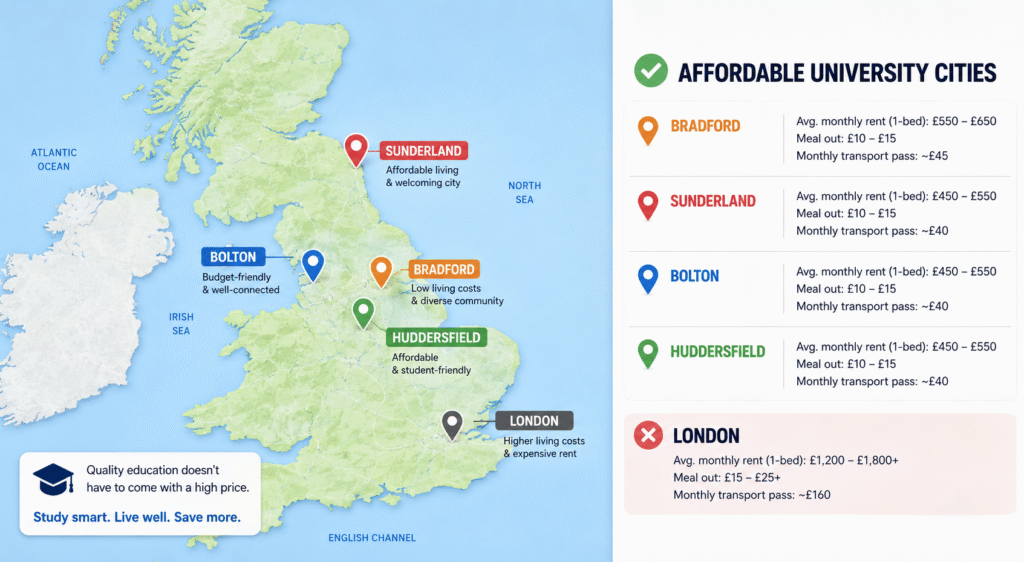
Cheap City or Cheap Degree? With These Affordable UK Universities, You Can Have Both
Here’s a detail that doesn’t get nearly enough airtime: tuition fees are only half the budget equation. Your cost of living — rent, food, transport, social life — can easily exceed your tuition in expensive cities. London is the obvious culprit, but Edinburgh, Bristol, and Brighton aren’t far behind.
The most financially sensible route for many international students? A low cost university in the UK located in the Midlands, the North of England, or Wales. Cities like Bradford, Sunderland, and Huddersfield offer:
- Average rent for a student room between £400–£600 per month (compared to £900–£1,400 in London)
- Shorter commutes, often walkable campuses
- Strong South Asian and international communities — which matters more than people admit when you’re living somewhere new
- Lower grocery, transport, and leisure costs across the board
Bangor in Wales deserves a special mention. It’s small, scenic, and one of the most affordable places to live as a student in the entire UK. The university punches above its weight in psychology and marine sciences, and the graduate visa still applies — you study there and then work anywhere in the UK.
Entry Requirements at Low Cost UK Universities for International Students — What’s Actually Flexible
Right. So you’ve found a university and a course. Now comes the part where many applicants stumble — not because they’re unqualified, but because they misread what “entry requirements” actually means in practice.
UK universities publish standard entry requirements. But they also exercise significant discretion. A student with strong grades in a relevant subject but a slightly lower English score might still receive an offer. A student with average grades but a compelling personal statement and relevant work experience might be admitted while someone with higher grades gets rejected. The system is more human than it appears.
⚠️ Common mistake: Applicants often self-reject before applying — they see a grade requirement, assume they don’t qualify, and never submit. In reality, contextual admissions, foundation pathways, and direct negotiation with admissions teams can open doors that look closed from the outside.
For international students specifically, the English language requirement is often the sticking point. Most universities accept IELTS 6.0–6.5 for undergraduate entry, though nursing and social work courses typically require 7.0. If your score is borderline, a pre-sessional English programme (usually 6–10 weeks, sometimes free or low cost) can bridge the gap.
Foundation year programmes are another underused route. Rather than abandoning the idea of studying in the UK because your A-levels or equivalent don’t map cleanly onto the system, a one-year foundation course at the university itself gets you in — and flows directly into Year 1 of your degree. Level 3–5 diploma routes work similarly and are often cheaper still.
Scholarships That Actually Exist — and How to Find Them Before the Deadline
The scholarship landscape for international students at low cost universities in UK is real, but fragmented. You won’t find a single portal that lists everything. Here’s how it actually works:
University-specific scholarships — most affordable universities offer their own awards, typically ranging from £1,000 to £5,000 off tuition. These are often merit-based, sometimes need-based, and almost always first-come-first-served once applications open. Sunderland, Leeds Beckett, and Teesside are particularly active with these awards.
Government-backed funding — the Chevening Scholarships (for postgraduate students) remain one of the most prestigious routes. There’s also the Commonwealth Scholarship Commission for students from eligible countries. These are competitive, but not impossibly so — the application quality matters more than raw grades.
Subject-specific funding — nursing is a notable case where NHS-linked bursaries and grants can significantly offset tuition and living costs. If you’re considering healthcare, do not skip this research.

How to Secure Admission at Low Cost UK Universities for International Students — Step by Step
UCAS is the centralised application system for undergraduate study in the UK. You apply for up to five courses simultaneously, using a single personal statement. Postgraduate applications go directly to universities. That’s the framework. The reality is messier.
For undergraduate applicants:
- Register on UCAS and select up to 5 universities and courses
- Write your personal statement — 4,000 characters, no fluff tolerated
- Submit academic transcripts and English language test scores
- Receive offers (conditional or unconditional) and decide on Firm and Insurance choices
- Meet conditions — usually grade requirements or English scores
- Apply for your Student Visa (CAS) once you have an unconditional offer
Postgraduate applicants bypass UCAS entirely — you apply directly to each university. Some courses require a research proposal; most taught Masters programmes just need transcripts, a personal statement, and English scores. The UK Masters admissions process has its own quirks worth understanding before you start.
The Student Route visa requires a Confirmation of Acceptance for Studies (CAS) from your university, proof of finances (usually 9 months of living costs plus tuition), and a valid English test score. Plan at least 6–8 weeks for the visa process.
The Diploma-to-Degree Shortcut That Makes Low Cost Universities in UK for International Students Even Cheaper
Here’s something genuinely underappreciated: the Level 4, 5, and 6 diploma system. Rather than entering a full three-year undergraduate degree at Year 1, many international students complete a Level 5 Higher National Diploma (HND) — typically two years — and then transfer directly into Year 3 of a UK university degree through a Level 6 top-up programme.
The financial case is compelling. A two-year HND at a private college often costs less than one year of standard university tuition. You arrive in Year 3 with existing credit, spend one year completing the degree, and graduate with a full honours degree. Total study time: three years. Total cost: often 30–40% less than the conventional route.
It’s not for everyone — you need to research which universities accept specific HND providers — but for students from countries where a UK degree carries significant career value, it’s a legitimate and increasingly popular path. Level 3–5 diploma programmes also provide a stepping stone for those who don’t yet meet direct entry requirements.
| Pathway | Duration | Typical Total Cost | Who It Suits |
|---|---|---|---|
| Direct undergraduate (3 yrs) | 3 years | £33,000–£54,000 | Students meeting standard entry requirements |
| Foundation + degree (4 yrs) | 4 years | £40,000–£62,000 | Those needing academic bridging |
| HND + top-up degree (3 yrs) | 3 years | £22,000–£36,000 | Cost-conscious students, non-traditional entry |
| One-year taught Masters | 1 year | £10,000–£14,000 | Graduates seeking a fast postgraduate qualification |
| Online/blended degree | 2–4 yrs | £6,000–£16,000 | Working professionals needing flexibility |
Costs are indicative and exclude living expenses. Check individual university pages for current figures.
Courses Where Affordable UK Universities Actually Deliver Strong Career Outcomes
Not all degrees carry equal weight in the jobs market — that’s a truth nobody likes saying out loud, but it shapes real decisions. The good news is that the most employable disciplines are often available at low cost universities in UK for international students. A few worth specific attention:
Nursing and Healthcare. Regulated by the NMC, recognised globally, and in perpetual demand within the NHS. BSc Adult Nursing, Mental Health Nursing, and Children’s Nursing are available at several affordable institutions. The graduate route visa, combined with NHS job demand, makes this one of the clearest ROI cases for international students.
Computing and Cyber Security. Tech skills have a near-universal employer market. Courses in Computing with Cyber Security at mid-tier universities are solid, particularly where institutions have industry partnerships or placement years built in.
Business and Management. Ubiquitous, yes — but for a reason. A Business Management degree from a UK university opens doors in finance, consulting, HR, and operations across multiple countries. The course quality at affordable universities is often indistinguishable from pricier alternatives once you strip away the brand.
Law. UK law degrees retain international prestige. Studying law in the UK at universities like Bangor or De Montfort costs considerably less than London alternatives, without compromising the academic rigour that makes the qualification valuable.
Ready to Apply? Here’s Where to Get Proper Help
The team at Uni Student HUB specialises in end-to-end admissions support for international students — from course selection and personal statement reviews to CAS guidance and pre-departure orientation. They work across undergraduate, postgraduate, and diploma routes, with direct university placement services and scholarship advisory built in.
Given how quickly university intakes fill and how short some scholarship windows are, getting proper guidance early genuinely changes outcomes — not just for the application, but for the overall financial picture.
📍 107 Fleet St, London EC4A 2AB 📞 +44 7361 804843 🌐 unistudenthub.com/contact-us/
Frequently Asked Questions
Which are the cheapest universities in the UK for international students?
Universities like the University of Sunderland, University of Bolton, and Teesside University consistently rank among the most affordable for international students, with tuition fees starting from around £11,000–£12,000 per year. However, “cheapest” varies by course — always check the specific programme fee rather than a general university figure.
Are low cost universities in the UK for international students still good quality?
Yes. All UK universities — regardless of fee level — are regulated by the Office for Students (OfS) and must meet national quality standards. Their degrees are recognised by UKVI, appear on the graduate visa list, and are accepted by employers globally. Fee differences largely reflect location costs and institutional branding, not teaching quality.
Can I work while studying at a low cost UK university as an international student?
Yes — most Student Route visas allow up to 20 hours of work per week during term time, and full-time work during vacations. This can meaningfully offset living costs, though you should not plan your entire budget around part-time income as hours aren’t always guaranteed.
What IELTS score do I need for affordable UK universities?
Most undergraduate programmes at low cost universities in the UK for international students accept IELTS 6.0 overall with no band below 5.5. Postgraduate courses typically require 6.5. Healthcare, nursing, and social work programmes usually require 7.0 in all bands. Some universities also accept TOEFL or Pearson PTE as alternatives.
How do I apply for scholarships at UK universities?
Most university-specific scholarships require a separate application after receiving your admissions offer. Check the university’s international scholarships page as soon as you’re offered a place. Government schemes like Chevening and Commonwealth Scholarships have their own portals and earlier deadlines — usually 12–18 months before the course starts.
Is the Level 6 top-up degree route recognised by employers?
Yes — a top-up degree results in a full Bachelor’s Honours degree (BSc/BA Hons), which is indistinguishable on a CV from a conventional three-year degree. Employers see the final qualification, not the route taken to get there.
What is the Graduate Route visa and do affordable UK universities qualify?
The Graduate Route Visa allows international graduates to remain in the UK for two years (three for PhD graduates) to work without needing a job offer first. It applies to graduates from all eligible UK universities — including all the affordable institutions listed in this article. The visa applies to the degree, not the university’s prestige ranking.