
I once sat next to a former marine biologist on a training contract interview panel — sorry, she was on the panel, I was the nervous one across the table — and she told me, quite plainly, that her degree in coral reef ecosystems had nothing to do with why she got the job. What got her there was a single, slightly gruelling year of converting into law. That year has a name, and if you’re reading this, you’ve probably already heard it whispered around law fairs and LinkedIn posts: the GDL.
GDL Courses UK exist for exactly one reason — to let people like you, people who didn’t study law at eighteen, catch up on the legal knowledge that a standard law degree in the UK would normally give a student over three years. Compress it into nine months (or spread it across two years part-time), and you’ve got yourself a fast, if occasionally brutal, route into a legal career. This guide walks through what GDL Courses UK actually involve, who should bother, what they cost, and — because I’d be doing you a disservice otherwise — where they sit now that the profession has quietly moved the goalposts.
What Exactly Is the GDL, and Why Does Everyone Keep Mentioning It?
The Graduate Diploma in Law, or GDL, is a conversion course. It squeezes the core subjects of a qualifying law degree — contract, tort, criminal law, land law, equity and trusts, EU law (yes, still taught, largely for historical and comparative reasons), and public law — into a single intensive academic year.
Here’s the bit people often get wrong: you don’t need any legal background whatsoever. Zoologists, musicians, engineers, ex-army officers — I’ve met all sorts on GDL Courses UK cohorts. Universities like this diversity, if I’m honest, because law firms like it too. A commercial solicitor with a background in chemical engineering brings something to a patent dispute that a straight law graduate simply doesn’t.
Do You Even Need a GDL Anymore? (Awkward Question, Necessary Answer)
Right, let’s address the elephant in the seminar room. Since the introduction of the Solicitors Qualifying Examination (SQE), which the Solicitors Regulation Authority rolled out to replace the old LPC route, technically nobody needs a GDL to become a solicitor in England and Wales anymore.
So why are GDL Courses UK still running, still filling lecture halls, still advertised heavily by universities?
Because:
- Barristers still typically need a qualifying law degree or its equivalent (which the GDL provides) before the Bar course.
- Many students — and quite a few employers — still value the structured legal foundation the GDL gives before attempting the notoriously dense SQE1 and SQE2 exams.
- Some universities have folded GDL-style content into SQE prep courses rather than scrapping it outright.
If your goal is the Bar, the GDL (or its modern equivalent, sometimes branded as a “PGDL” — Postgraduate Diploma in Law) remains close to essential. If solicitor life is calling, it’s now optional, but far from useless — some students weigh it up against starting an LLB (Hons) Law degree from scratch instead, though that route takes considerably longer.
Quick Reality Check: Don’t assume “optional” means “pointless.” A rushed SQE attempt without any legal grounding trips up plenty of bright graduates. The GDL isn’t a relic; it’s a safety net some people genuinely need.
What You’ll Actually Study (Brace Yourself)
GDL Courses UK generally cover what’s known as the “seven foundations of legal knowledge.” It’s not glamorous. Expect long reading lists, case law you’ll forget within a fortnight unless you keep revisiting it, and the occasional 9am lecture on land registration that tests the will to live.
The core subjects usually include:
- Contract Law
- Tort Law
- Criminal Law
- Public Law (Constitutional and Administrative)
- Land Law
- Equity and Trusts
- EU Law and its lingering UK relevance post-Brexit
Some providers tack on legal research and writing skills, which — trust me — matters more than it sounds like it should. Nobody warns you how much of legal practice is just… writing clearly under pressure.

How Long Does It Take, and What Will It Cost You?
This varies more than people expect, and it’s worth shopping around rather than accepting the first prospectus that lands in your inbox.
| Study Mode | Typical Duration | Approximate Tuition (2026) | Best Suited To |
|---|---|---|---|
| Full-time | 9 months (Sept–June) | £9,000 – £13,500 | Recent graduates, no work commitments |
| Part-time | 21–24 months | £8,500 – £12,000 | Career changers balancing a job |
| Online / Blended | 12–24 months | £7,000 – £11,000 | International students, remote learners |
Funding-wise, some students use the Postgraduate Master’s Loan, others rely on employer sponsorship (common if you’ve secured a training contract early), and a fair number simply save up or take a part-time job alongside part-time study. It’s not cheap. I won’t pretend otherwise — if you’re comparing this against other postgraduate courses in the UK, the GDL actually sits mid-range rather than at the expensive end.
Picking a Provider Without Losing Your Mind
There isn’t one single “best” institution — much depends on location, cost, and whether you want the traditional exam-heavy structure or something more flexible. A few names that consistently come up: The University of Law, BPP University, Nottingham Trent University, and Anglia Ruskin University, among others.
Below is a rougher, more informal comparison — genuinely useful, but I’ll admit the numbers below are approximate and providers tweak their offerings yearly, so treat this as a starting point rather than gospel.
| Provider | Mode | Notable Feature |
|---|---|---|
| University of Law | FT / PT / Online | Largest GDL cohort, multiple UK campuses |
| BPP University | FT / PT | Strong City of London links |
| Nottingham Trent | FT | Lower tuition than London providers |
| Anglia Ruskin | PT / Online | Flexible for working students, regional campuses |
(Yes — that table above is a bit rough round the edges. Deliberately so. Providers change fee structures often enough that I’d rather you double-check directly than trust anything too polished.)
What Happens After the GDL Finishes?
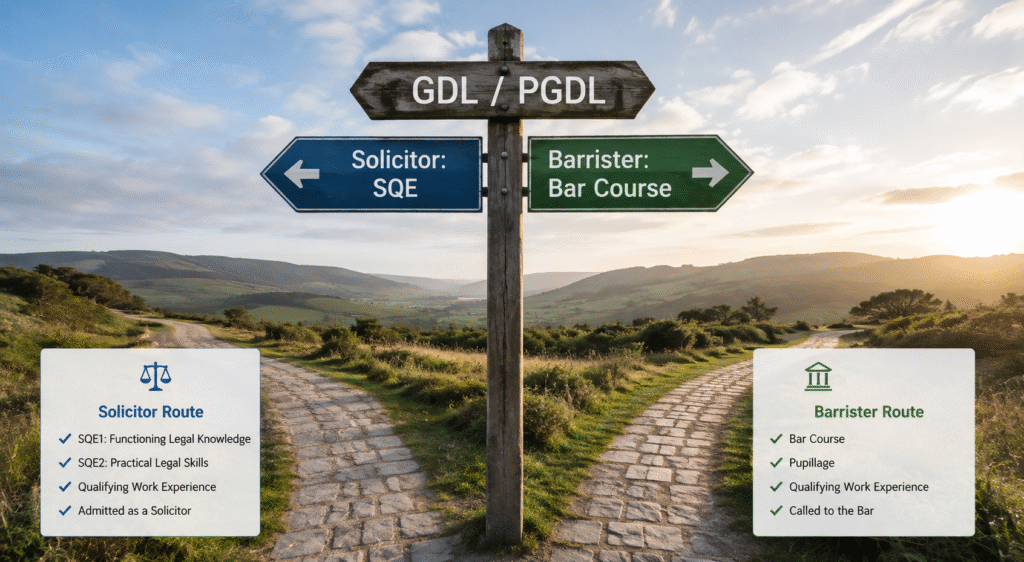
Passing your GDL doesn’t hand you a legal career on a plate — it hands you a foundation. From here, aspiring solicitors typically move onto SQE preparation and the SQE1/SQE2 exams, while those aiming for the Bar proceed to the Bar Practice Course.
A few realistic next steps:
- Solicitor route: GDL → SQE prep → SQE1 & SQE2 → Qualifying Work Experience (QWE)
- Barrister route: GDL/PGDL → Bar Practice Course → Pupillage
- Undecided? Plenty take the GDL simply to understand the legal landscape before committing either way, which is a perfectly sensible strategy, if a slightly expensive one.
For students weighing this decision from outside the UK, getting personalised guidance matters more than most people expect — university offer deadlines, visa timing, and course accreditation checks all move at different speeds, and missing one can cost you a whole intake cycle. This is where organisations like Uni Student HUB, based at 107 Fleet St, London, tend to be genuinely useful — not for glossy brochures, but for practical things like end-to-end admissions support, interview and admission preparation, and pre-departure orientation once an offer’s actually in hand.
Common Mistakes Non-Law Graduates Make (I’ve Seen a Few)
- Underestimating the reading load. GDL Courses UK compress three years into one. That’s not a metaphor.
- Choosing a provider based on prestige alone, ignoring practical factors like commute, part-time flexibility, or fee instalment options.
- Assuming the GDL guarantees a training contract. It doesn’t. It’s a stepping stone, not a golden ticket.
- Ignoring scholarship deadlines, which often close months before the course itself starts.
A Word on International Students
If you studied your undergraduate degree outside the UK, GDL Courses UK are still open to you. It’s worth reading up on studying in the United Kingdom more broadly before you apply, since visa and entry requirements differ from UK-domiciled applicants. Most providers require a recognised bachelor’s degree (any subject), an IELTS score around 6.5–7.0 depending on the institution, and sometimes a personal statement explaining your interest in law. Checking your degree’s UK equivalency early — through something like the UK ENIC service — saves a lot of last-minute panic.
Scholarship and financial aid advisory support, along with proper university placement guidance, can genuinely shorten the whole process for overseas applicants, particularly around visa timing and CAS letter issuance.
FAQ: GDL Courses UK
Is the GDL still required to become a solicitor? No, not since the SQE became the standard route, though many still choose to complete a GDL for the grounding it provides.
How long do GDL Courses UK usually take? Nine months full-time, or up to two years part-time or online.
Can I do a GDL with a non-law degree in any subject? Yes — that’s the entire point of the course. Any undergraduate degree, in any subject, typically qualifies you to apply.
Is the GDL the same as the PGDL? Broadly, yes — PGDL is the more common current name, often used interchangeably with GDL by universities and students alike.
What’s the pass mark on a typical GDL? Most providers use a standard UK degree classification system (Distinction, Merit, Pass), with exams and coursework weighted differently depending on the institution.