
There’s a very specific kind of panic that hits at 1am when you’re three browser tabs deep into UK tuition fee calculators, and the number on screen is roughly your family’s annual income. This guide to low cost universities in UK for international students exists precisely because of that panic — I’ve watched it happen to more students than I can count: bright, determined, entirely capable people who quietly shelve the idea of studying in Britain because someone told them it costs £30,000 a year, no exceptions. It doesn’t. Not always. Not if you know where to look.
This article exists to correct that. Because low cost universities in UK for international students aren’t some rumour whispered on Reddit threads — they’re real, regulated, degree-awarding institutions, and several of them sit comfortably inside the same national quality framework as their pricier cousins in London and Oxford. The gap between “affordable” and “prestigious enough to matter to employers” is much narrower than the marketing brochures let on. Teams like Uni Student HUB spend their working days untangling exactly this — matching students to low cost universities in UK for international students that fit both budget and ambition, then walking them through the paperwork maze that follows.
So let’s get into it properly: which universities actually qualify as low cost universities in UK for international students, what “cheap” really means once you factor in rent and visas, and — because a low fee means nothing if your application gets rejected — how admission works when you’re trying to do this affordably and quickly.
What Low Cost Universities in UK Actually Means Once You Do the Maths
Here’s the bit nobody puts on the homepage banner: tuition fees are only one slice of the pie. A university charging £11,750 a year in a small northern city can end up cheaper overall than one charging £13,000 in outer London, purely because rent, transport and the weekly shop cost so much less once you’re outside the M25.
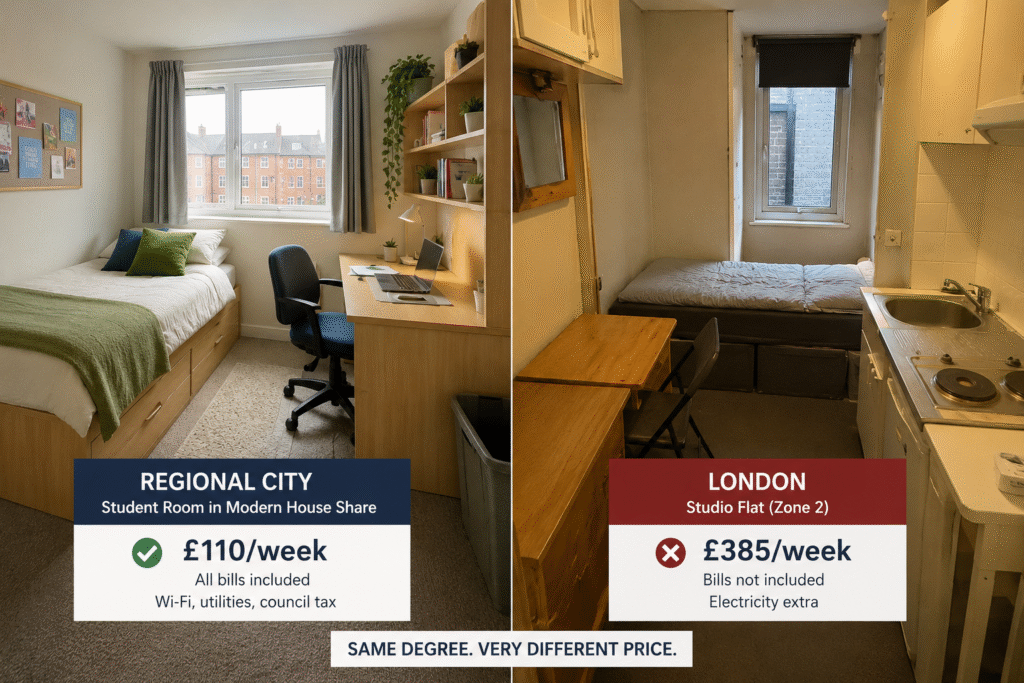
Home (UK) undergraduate fees are capped by the government — £9,790 for courses starting in the 2026–27 academic year — but that cap doesn’t apply to international students, whose fees are set independently by each institution. This is precisely why low cost universities in UK for international students tend to cluster in regional cities rather than the capital: Middlesbrough, Sunderland, Bolton, Ipswich, Chester, Wrexham. Smaller cities, smaller rents, smaller headaches.
A rough (and I mean rough — always check the current figures) breakdown looks like this:
- Undergraduate degrees at budget-friendly UK universities: roughly £11,000–£17,000 per year
- Postgraduate/Master’s at the more affordable end: roughly £11,000–£16,000 per year
- Living costs outside London: typically £900–£1,300 a month depending on lifestyle and city
- Living costs inside London: often £1,200–£1,800 a month, sometimes more
Notice how tuition and rent sit in overlapping ranges? That’s the whole game. Chase the total number, not just the headline fee.
| University | City | Approx. UG Fees (per year) | Known For |
|---|---|---|---|
| University of Sunderland | Sunderland | £11,750 – £14,500 | Business, Computing, Health Sciences |
| Teesside University | Middlesbrough | £15,000 – £17,500 | Digital, Computer Science, Nursing |
| University of Bolton | Bolton | £12,000 – £14,000 | Engineering, Business, Foundation routes |
| Leeds Beckett University | Leeds | £14,000 – £17,000 | Sport Science, Architecture, Business |
| University of Suffolk | Ipswich | £12,500 – £15,000 | Health Sciences, Computing, Business |
| University of Greenwich | London (riverside) | £15,500 – £18,000 | Architecture, Engineering, Business |
Figures are indicative and change yearly — always confirm current fees directly on each university’s admissions page, or ask a consultant who checks these lists weekly (guilty, that’s basically our job).
You’ll notice Teesside comes up constantly in these conversations — courses at Teesside University span everything from digital media to nursing, and its Middlesbrough campus is one of the more genuinely low-cost places to live in England.
Regional Cities With the Cheapest Universities in the UK
I’ll be honest — when I first started looking into this properly, I assumed “cheap city” would automatically mean “boring city.” Wrong. Sunderland has a coastline. Chester has a two-thousand-year-old Roman wall running straight through it. Ipswich is twenty-something minutes from London by train if you time it right.
The recurring names on almost every list of low cost universities in UK for international students share a pattern: they’re northern, coastal, or just quietly under-the-radar.
- Sunderland — low rent, strong business and computing programmes, easy rail links
- Middlesbrough (Teesside) — one of England’s most affordable student cities, digital-industry focused
- Bolton — Greater Manchester’s cheaper neighbour, practical and career-oriented courses
- Chester — historic, walkable, strong in health sciences and education
- Ipswich (Suffolk) — East Anglia’s quieter option, close enough to London when you need it
- Wrexham — Wales’ newly minted university city, some of the flattest tuition fees in the country
If your budget genuinely can’t stretch to London rents, pick your course first and your city second — but don’t dismiss these places as consolation prizes. Several of them post graduate employment rates that would surprise people who’ve never heard of them.
How to Secure Admission at Low Cost Universities in UK
Right, onto the part everyone skips past to get to the fee tables, which is a mistake, because a cheap course you can’t get admitted into is worth precisely nothing.
Admission to affordable UK universities generally follows the same skeleton as everywhere else — but the details differ just enough to matter.
1. Pick the course before the university. Search by subject on UCAS rather than by prestige. A £12,000 course that matches your career goals beats a £25,000 one that vaguely sounds impressive.
2. Check entry requirements early — nursing especially. Health-related courses often carry additional criteria around English proficiency and clinical placements; entry requirements for nursing are a good example of a pathway with extra steps most students don’t discover until it’s too late.
3. Apply through the right route. Some low cost universities in UK for international students accept direct applications outside UCAS for certain programmes, particularly foundation and top-up degrees — routes like nursing top-up or business management top-up exist specifically for students who’ve already completed a diploma and want a faster, cheaper finish line.
4. Sort your documents before you’re asked twice. Transcripts, English test scores (IELTS/PTE/Duolingo, depending on the university), a personal statement, and — this trips up more people than anything else — a financial statement proving you can cover fees and living costs for the maintenance requirement.
5. Get your CAS, then apply for your visa. Once an offer is unconditional, the university issues a Confirmation of Acceptance for Studies (CAS), which you’ll need for the UK Student visa application itself.
Quick reality check: low fees do not soften a weak application. Admissions teams at budget-friendly universities still reject inconsistent documents and vague personal statements just as readily as Russell Group institutions do. Cheap and easy are not the same thing — treat the application with the same seriousness you’d give a scholarship pitch.
This is roughly where Uni Student HUB tends to get pulled into the conversation — end-to-end admissions support, interview and admission preparation, and pre-departure orientation, essentially covering the gap between “I’ve found a low cost university in the UK” and “I’m actually sitting in the lecture hall in September.”
Scholarships That Make Budget-Friendly UK Universities Even Cheaper
A surprising number of students never apply for anything beyond the base tuition fee, purely because scholarship pages read like legal documents nobody has time to parse. Don’t skip this step — it’s frequently free money sitting behind a two-paragraph form.
- Automatic international scholarships — many affordable UK universities apply a discount (often £1,000–£3,000) directly to your first invoice with zero separate application
- Chevening Scholarships — UK government-funded, fully covers a one-year Master’s, highly competitive
- Commonwealth Scholarships — aimed at students from Commonwealth countries, often covering fees, flights and a living allowance
- Country-specific merit scholarships — South Asia, West Africa and Southeast Asia discounts appear frequently at regional universities chasing diverse cohorts
Worth saying plainly: scholarship money stacks with low tuition. A student choosing between a £20,000 course with a £5,000 scholarship and a £13,000 course with a £2,000 automatic discount should run the actual arithmetic — sometimes the “prestigious” option still loses.
Hidden Costs at Cheap Universities in the UK (Fair Warning: It’s a Bit Messy)
Budgets rarely fall apart because of tuition. They fall apart because of the stuff nobody mentions until week three. Here’s a rougher breakdown — genuinely rougher, because these numbers wobble by city, lifestyle, and how many takeaways you allow yourself on a Friday.
| Cost item | London | Regional cities | Notes |
|---|---|---|---|
| Accommodation | £700–£1,200/month | £400 – 700 monthly | Halls vs private varies a lot |
| Student visa fee | £558 (as of April 2026) | Check gov.uk before applying — this changes | |
| Immigration Health Surcharge | Varies by visa length | Paid upfront per year of study | |
| Food & groceries | £200-250/mo | £150–£220 a month | Cooking vs eating out, obviously |
| Transport | £100–£180/month | £40 to £90 | Many regional cities are walkable |
(Yes, that table’s a bit uneven — deliberately left it that way, because real cost-of-living data usually is. Sources conflict, cities differ, and anyone promising perfectly tidy numbers is probably guessing.)
Two extra costs students consistently underestimate: the Immigration Health Surcharge (paid as part of the visa, giving access to the NHS) and proving maintenance funds — currently in the region of £1,171–£1,529 a month depending on whether you’re studying in London, held in your account for a specific period before you apply. Get the exact current figures from UKCISA before you submit anything, since these thresholds move.
Choosing Between Foundation, Top-Up and Direct Entry
Not every student walks the standard three-year undergraduate path, and honestly, for budget-conscious applicants, that’s often a good thing. Top-up degrees — where you complete a diploma or foundation qualification first, then join a UK degree in the final year — can dramatically cut total cost and time. Courses such as health and social care top-up or the banking and finance top-up route exist precisely for this — one focused year of UK study, one UK-recognised degree, considerably less spent overall.
If nursing is the goal specifically, it’s worth reading up separately, because clinical placement requirements shift the calculation quite a bit — the complete guide to studying nursing courses is a reasonable starting point before comparing universities.
Where London Fits Into an Affordable Plan
I get asked this constantly: “can I study affordably and be in London?” Sort of. Universities like Greenwich and London Metropolitan University sit at the more reasonable end of London’s fee scale, and both lean into areas of the city where rent hasn’t caught up with Zone 1 prices yet. It’s not the same as choosing Sunderland or Bolton — you’ll still pay more overall — but it’s a legitimate middle path if the London ecosystem genuinely matters to your career plans (finance, media, and international business students often make this trade-off deliberately).
Common Mistakes When Choosing Cheap Universities in the UK
A few patterns show up again and again:
- Ignoring exchange rate volatility. A fee that looks manageable today can shift meaningfully by the time you pay it, particularly across two or three instalments.
- Skipping the total cost of living calculation and budgeting on tuition alone.
- Applying to a single university. Low cost universities in UK for international students still have limited scholarship pots — apply to two or three to keep options open.
- Underestimating visa processing time. Leave a buffer; visa services occasionally slow down during peak intake months.
- Choosing a course by fee alone, ignoring whether it actually leads anywhere professionally.
If any of that sounds like it’s happened to someone you know (or, no judgment, to you) — this is genuinely the kind of thing scholarship and financial aid advisory exists to catch before it becomes a crisis rather than after.
A Quick, Honest Word on “Cheap Doesn’t Mean Lesser”
I want to push back on an assumption that creeps into these conversations uninvited: that affordable somehow equals second-rate. UK degrees, regardless of the issuing university’s fee bracket, sit within the same national quality assurance framework, checked by the same regulatory bodies. Employers assessing a graduate’s CV are, in practice, usually far more interested in the degree classification, the placement experience, and the skills demonstrated at interview than the sticker price of the tuition three years earlier. A £13,000 computing degree from Teesside and a £24,000 computing degree from a big-name London institution both result in a UK-recognised BSc — what differs is largely reputation weight in specific, narrow industries, not blanket quality.
FAQs About Low Cost Universities in UK
What are the cheapest universities in the UK for international students right now? Universities such as Sunderland, Bolton, Teesside, Suffolk, Wrexham and Leeds Beckett regularly appear among the more affordable options, with undergraduate fees often starting around £11,000–£15,000 per year — though figures shift annually, so always verify directly with the institution.
Are low cost universities in UK for international students still UKVI-approved? Yes. Every legitimately operating UK university, regardless of fee level, must hold a valid sponsor licence to issue a CAS and support international student visas — fee level has no bearing on this status.
Is it harder to get admission to a cheaper university? Not necessarily harder — but it’s not automatically easier either. Entry requirements still apply, and weak applications get rejected regardless of tuition fees.
How much does it cost to live in the UK as an international student outside London? Realistically somewhere between £900 and £1,300 a month, covering rent, food, transport and basics, though this depends heavily on city and lifestyle choices.
Can I combine a scholarship with an already low tuition fee? Generally yes — automatic international scholarships typically stack with a university’s base fee, and external scholarships like Chevening or Commonwealth awards operate independently of institutional discounts.
Do education consultants charge students directly? Practices vary. Some consultants, including services offered through firms like Uni Student HUB, work on models where guidance and admissions support come at no direct cost to the student, funded instead through university partnerships — always confirm the fee structure upfront before committing.
Getting Practical Help With the Process
None of this needs to be navigated solo. If you’re comparing low cost universities in UK for international students and the sheer number of tabs open on your laptop has become genuinely unmanageable, it might be worth a proper conversation rather than another late-night scroll. Uni Student HUB, based at 107 Fleet St, London EC4A 2AB, works through exactly this — study in UK guidance, education consultancy, interview and admission preparation, scholarship and financial aid advisory, university placement services, and pre-departure orientation once your offer’s confirmed. You can reach the team directly on +44 7361 804843 for a conversation about which affordable universities actually fit your course, budget and timeline — not just the ones topping a generic list.
For related reading, the guides on studying law in the UK, hospitality and hotel management courses, and top medical universities in the UK cover subject-specific admission routes in more depth, and the broader UK study category rounds up further destination and course guides.