
There’s a specific kind of panic that hits somewhere around September, when you notice everyone on LinkedIn is either already living in Manchester or knee-deep in a postgraduate portal you didn’t know existed until last Tuesday. If you’re weighing up an MA in UK institutions — and let’s be honest, you probably are, or you wouldn’t still be reading — you’re about to enter a system that’s simultaneously more straightforward and more baffling than anywhere else on the planet. One year. That’s the headline figure everyone throws at you. A full Master of Arts, done and dusted, while your mates doing the same thing in Toronto or Melbourne are still two years deep and mildly resentful about it.
So yes, an MA in UK universities is fast. It’s also expensive, oddly bureaucratic in places, and genuinely one of the better academic decisions a lot of international students will make in their twenties (or thirties, no judgement). This guide walks through what actually matters — not the polished brochure version, the version with the awkward bits included.
So, What Actually Counts as an MA in UK Higher Education?
Quick housekeeping first, because the terminology trips people up constantly. In Britain, “MA” specifically refers to a Master of Arts — humanities, social sciences, education, media, that sort of territory. If you’re going into a science, engineering, or maths-heavy subject, you’re more likely doing an MSc. Business tends to sit under an MBA or MSc Management. Confusingly, some universities slap “MA” onto programmes that feel more technical than artistic, purely for historical reasons (Scottish universities are particularly guilty of this — an MA at St Andrews can mean something quite different to an MA at, say, a modern post-92 institution).
What unites almost every MA in UK institutions, though, is structure: roughly 180 credits, split across two taught semesters and a summer dissertation, delivered inside twelve months. Compare that to a two-year Master’s in the US or a good chunk of Europe, and you start to see why the UK punches above its weight for international applicants who want a qualification without putting their entire life on pause.
Why So Many International Students Land Here Anyway
I’ll be honest — the one-year timeline does most of the persuading on its own. Less tuition overall, less accommodation, less time away from a career or family. But there’s more going on underneath that.
- Global name recognition. A postgraduate degree in Britain from a Russell Group university (or several well-regarded post-92s, don’t discount them) still carries serious weight with employers across Asia, the Middle East, and Africa especially.
- Teaching intensity. Seminars, not just lectures. You’re expected to argue, not just absorb.
- The Graduate visa route. More on this later, but the ability to stay and work post-study genuinely changes the maths for a lot of applicants.
- Cultural proximity to research hubs. London, Edinburgh, Manchester — these aren’t just cities, they’re functioning ecosystems of the exact industries a lot of MA graduates want to enter (publishing, policy, media, the arts).
None of this means an MA in UK universities is automatically the right choice for everyone. If you need two years to properly absorb a subject shift, or you thrive with a slower academic pace, the compressed UK model can feel like drinking from a fire hose. Worth sitting with that honestly before you commit.
The Application Clock — When You Actually Need to Start Moving
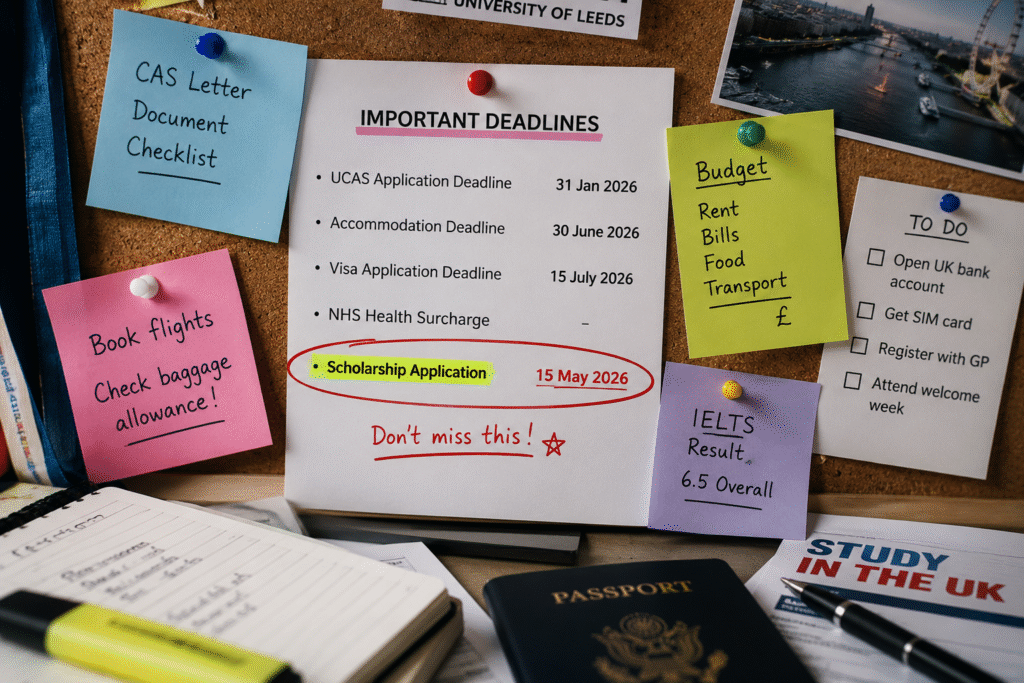
This is where most applicants underestimate things. UK postgraduate admissions don’t run on the rigid, single-deadline system you might expect from UCAS undergraduate applications. Most universities operate rolling admissions — which sounds relaxed until you realise popular courses and scholarship pools close early, sometimes six or eight months before the intake.
| Stage | Recommended timing | What’s actually happening |
|---|---|---|
| Research & shortlisting | 12–14 months before intake | Comparing programme content, not just university rankings |
| English test (IELTS/PTE) & references | 9–11 months before | Booking test slots early — they fill up around peak season |
| Application submission | 6–9 months before | Personal statement, transcripts, references uploaded |
| Offer & scholarship decisions | 4–7 months before | Conditional or unconditional offers land here |
| CAS & visa application | 2–3 months before | Confirmation of Acceptance for Studies issued, Student visa opens |
| Pre-departure prep | 2–6 weeks before | Accommodation, flights, insurance, the last-minute scramble |
Quiet warning nobody puts in bold enough: scholarship deadlines almost always land earlier than course application deadlines. If you’re chasing funding for your MA in UK, treat the scholarship date as your real deadline, not the university’s official cutoff.
Choosing the Right Programme (and Not Regretting It Later)
Subject choice matters more than league table position, in my experience — a mid-ranked university with a genuinely strong department in your field will usually serve you better than a prestigious name teaching your subject as an afterthought. Worth digging into module lists, not just course titles.
Popular routes among international applicants pursuing a Master’s in the UK tend to cluster around a handful of areas: business and management, computing and cyber security, health and social care, education, psychology, and law. If any of those ring a bell, it’s worth browsing subject-specific pages — business management, computing and technology, health and social care, education, psychology of mental health and law are decent starting points to see how programmes actually differ between institutions.
University choice is its own rabbit hole. Institutions like Leeds, Sheffield, Durham, Cardiff, and Northumbria each have distinct strengths — some lean heavily into research output, others into industry placements and employability stats. The full list of universities and postgraduate courses is worth a proper afternoon of browsing rather than picking the first name you recognise.
If you’re specifically weighing subject-heavy guides, we’ve already done the deep dives on a few — the insider’s guide to UK Master’s programmes covers programme structure in more depth than we’ve got room for here, and if law or nursing is on your radar, the law degree guide and nursing scholarships breakdown are both worth a read.
Show Me the Money: Fees, Funding, and the Numbers Nobody Says Out Loud
Right, the bit everyone skips to. Tuition for an MA in UK universities varies wildly by subject and institution — arts and humanities programmes sit at the cheaper end, lab-based or clinical Master’s cost considerably more. Here’s a rough spread (and I’ll flag now: this table’s formatting gets a bit inconsistent toward the bottom, because real-world fee data genuinely is this messy — universities publish it differently, some in ranges, some as flat figures, some with footnotes buried three pages deep).
| Programme type | Typical annual fee (international) | Notes |
|---|---|---|
| Arts & Humanities MA | £14,000 – £19,000 | Often the most affordable route |
| Social Sciences / Education | £15,000–£21,000 | |
| Business & Management | £18,000 – 26,000 | MBA programmes sit higher still |
| Computing / Cyber Security | around £17k to £23k | lab access fees sometimes separate |
| Nursing & Health | varies hugely — check per uni |
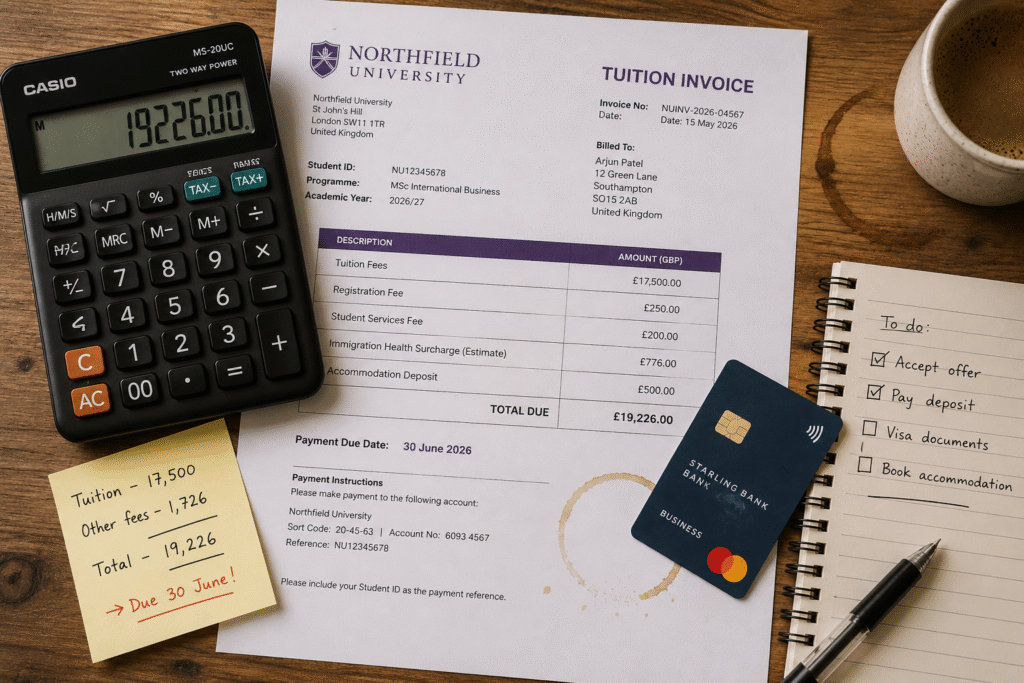
On top of tuition, budget realistically for living costs — London runs considerably higher than everywhere else, and the UK’s own student visa financial requirement figures (which change periodically) give a decent floor for what you’ll need to prove in your bank statements.
Funding-wise, most universities run their own scholarship pots specifically for international students — merit-based, subject-specific, or country-specific. There are also external routes like Chevening Scholarships and Commonwealth Scholarships for postgraduate study. This is genuinely one of the areas where getting guidance pays for itself; a lot of applicants miss scholarship windows simply because nobody told them the deadline sat months before the course deadline. Firms offering scholarship and financial aid advisory — including outfits like Uni Student HUB — exist precisely because this part of the process is more time-sensitive than people expect.
Entry Requirements Nobody Explains Properly
Academic requirements for an MA in UK institutions generally sit around a 2:2 or equivalent from your home country’s grading system, though competitive programmes and Russell Group universities often want a 2:1. English language proof is near-universal — IELTS Academic (usually 6.5 overall, 6.0 in each band) is the most common benchmark, though PTE Academic and TOEFL are accepted at plenty of institutions too.
Beyond grades, most applications want:
- A personal statement — genuinely read carefully, not a formality
- Two academic (occasionally professional) references
- A CV/résumé
- Transcripts and degree certificates, often needing translation and certification
- For some programmes, a writing sample or portfolio
Small tangent: the personal statement trips up more applicants than the grades do. Admissions tutors read hundreds of these and can spot a templated, generic one within a paragraph. Specificity about why this programme, why now genuinely moves the needle.
The Visa Bit — Student Route and What Comes After
Every international student pursuing an MA in UK institutions will need a Student visa (formerly Tier 4), issued once you’ve got your Confirmation of Acceptance for Studies (CAS) from your chosen university. You’ll need to demonstrate English proficiency, prove you can cover tuition and living costs, and pass a credibility interview in some cases. Full, current guidance sits on the UK government’s official student visa page — always check there directly, since financial thresholds and documentation requirements shift periodically.
Once you’ve finished, the Graduate visa route allows most graduates to stay and work (or look for work) in the UK for two years after completing a Master’s — a genuine differentiator compared to a lot of competing study destinations. The UKCISA website is a solid, independent resource for immigration questions that fall outside straightforward university guidance.
Reality check: visa rules for postgraduate students in the UK have shifted more than once in recent years — dependants’ rights, financial thresholds, work restrictions during study. Don’t rely on a forum post from two years ago. Check the official source, or get current guidance from an education consultant who tracks these changes for a living.
Life After Your MA in UK: Work, PhD, or Home?
Graduates generally split three ways. Some use the Graduate visa to enter the UK job market directly — competitive in London especially, less so in secondary cities with strong regional employers. Some head straight into a PhD, particularly common for those who’ve discovered a genuine research itch during the dissertation stage. Others take the qualification home, where a UK Master’s still opens doors in a lot of sectors, especially education, government, and multinational corporates.
Career services attached to your university matter more than people give them credit for — worth checking what’s on offer before you even accept an offer, not after you arrive.
Frequently Asked Questions About Doing an MA in UK
Is an MA in UK worth it for international students? For most people pursuing careers where the UK has strong sector reputation — publishing, policy, education, the arts, parts of tech — yes. The shorter duration also means a lower total cost than many two-year alternatives elsewhere.
How long does an MA in UK actually take? Almost always 12 months full-time, running from September/October through to submission of your dissertation the following autumn.
Can I work while completing my MA in UK? Student visa holders can typically work up to 20 hours per week during term time and full-time during official holidays, though this varies slightly by sponsor and course level — always confirm with your specific university.
What’s the difference between an MA and an MSc in UK universities? Broadly, MA covers arts, humanities, and social science subjects, while MSc covers science, technology, and quantitative fields. Some universities apply the labels inconsistently, so check the specific programme rather than assuming from the title alone.
Do I need an agent or consultant to apply for an MA in UK? Not strictly — plenty of students apply directly. That said, application timelines, scholarship windows, and visa documentation trip up a lot of first-time applicants, which is exactly the gap education consultants and study consultants are built to close.
Where This Leaves You
None of this is complicated once it’s laid out, but it is a lot to hold in your head while also finishing a degree, working, or juggling family expectations about “what’s next.” If you want a second pair of eyes on your shortlist, your personal statement, or your scholarship timeline, Uni Student HUB offers end-to-end admissions support, interview and admission preparation, scholarship and financial aid advisory, university placement services, and pre-departure orientation — the sort of unglamorous, detail-heavy work that makes the difference between a smooth application and a stressful one. They’re based at 107 Fleet St, London EC4A 2AB, and reachable on +44 7361 804843 if you’d rather talk it through than read another article.
Whatever route you take, treat the planning stage of your MA in UK application with the same seriousness you’ll bring to the dissertation itself. Future you, sat in a lecture hall in October, will be glad you did.