
Choosing where to study in the UK can feel overwhelming. You might be staring at dozens of browser tabs, conflicting tuition figures, and strict visa rules. Whether you are a school leaver, a mature learner, or an overseas applicant, a clear London university list makes everything easier. Right now, you may worry about your grades, London rent costs, or missing a key deadline. Take a deep breath. You do not have to figure this out alone, and you never need to guess your way through UK admissions.

In this guide, we break down universities in London for international students and UK residents alike. You will find realistic fee expectations, official UCAS and UKVI rules, and common errors to avoid. We also include a practical workflow to keep your application on track.
Understanding the London University List and Fees for 2027
London is home to more than 40 higher education institutions. They range from global research powerhouses to career-focused modern universities and specialist colleges. Every institution sets its own entry criteria, campus culture, and international fee bands. Comparing a London university list and fees side by side helps you shortlist your five UCAS choices or postgraduate applications.
For UK home students, the UK government caps standard full-time undergraduate tuition fees. Both Imperial College London and the University of Greenwich confirm these official rates. The standard full-time home undergraduate fee is £9,790 per year for 2026/27. For 2027/28 entry, that cap rises to £10,050 per year. International tuition fees are not capped by the government. They vary widely by institution and depend on whether your course is classroom-based, lab-based, or clinical.
London University List and Fees Comparison
Here is a practical snapshot of popular institutions from our universities directory:
| Institution | Best Known For | Home UG Fee (2027/28) | International Fee Overview | Explore More |
| Imperial College London | STEM, Engineering, Medicine, Business | £10,050 per year | Set per course (see Imperial fees) | Study in the UK |
| University College London (UCL) | Multidisciplinary Research, Architecture, Law | £9,790 (2026/27); 2027/28 TBC | Cohort guarantee applies; varies by programme (UCL fee schedules) | Postgraduate courses |
| University of Greenwich | Business, Computing, Nursing, Maritime Campus | £10,050 per year | Around £18,525 for courses like BSc Computer Science (Greenwich fees) | Greenwich University |
| London Metropolitan University | Accessible Degrees, Business, Cyber Security | Standard UK home cap | International UG starts from £19,500 per year; PG from £20,000 (London Met) | London Metropolitan |
| Birkbeck, University of London | Evening Teaching, Mature Learners, Flexible Study | Standard UK home cap | Varies by faculty and study mode | Birkbeck University |
| Royal Holloway, University of London | Humanities, Cyber Security, Campus Life near London | Standard UK home cap | Varies by course and department | Royal Holloway |
| University of Roehampton | Education, Psychology, Health, Southwest Campus | Standard UK home cap | Varies by undergraduate and postgraduate band | Roehampton University |
Choosing Between Russell Group and Modern London Universities
Notice how different these London institutions feel. If you work full-time in London, Birkbeck’s evening teaching model may suit you better than daytime classes. If you want value-focused universities in London for international students, look closely at Greenwich or London Metropolitan. They often offer regional bursaries, January intakes, and lower fees than central Russell Group campuses. You can also explore our guide to low-cost universities in the UK for international students.
How to Pick the Best London Uni for International Students
There is no single best London uni for international students or UK applicants. The right choice depends on your career goals, budget, and learning style. Instead of chasing rankings blindly, ask yourself four simple questions before locking in your shortlist:
- Does the course include an accredited placement? Many students gain real career momentum from a sandwich year or industry project. Read more in our year placement UK universities guide.
- Which London zone is the campus in? Studying in Zone 1 puts you close to major employers. Campuses in Zones 2, 3, or 4 (like Greenwich or Roehampton) often have lower nearby rent costs.
- Are there multiple intake dates? Most Russell Group degrees start in September. However, several modern universities offer January or May intakes for select undergraduate courses and postgraduate programmes.
- What student support is available? Check for academic writing workshops, disability adjustments, and dedicated international orientation teams.
Core Admission, Funding, and Visa Rules for London Universities
Before you submit a single form, learn the official rules for admissions, finance, and visas. Policies update often. Always double-check official government portals alongside your chosen university’s website.
UCAS Deadlines for Your London University List
Full-time undergraduate applicants normally apply through UCAS. For 2027 entry, the application fee is £34.50 for up to five choices (UCAS). Keep these two primary dates from the official UCAS dates and deadlines calendar in your diary:
- 15 October 2026: This is the deadline for Medicine, Dentistry, and Veterinary Medicine or Science. It also covers all applications to Oxford or Cambridge.
- 13 January 2027 (18:00 UK time): This is the equal consideration deadline for most other 2027 undergraduate courses. Universities must consider all on-time applications equally. Late applications may still be accepted if spaces remain, though competitive London courses fill up fast.
Postgraduate taught applications (such as MSc, MA, or MBA degrees) usually go directly to each university. Deadlines vary by institution and intake. International applicants should apply early to leave enough time for offer processing and visa checks.
Student Finance Eligibility for London Universities
Funding is often the biggest worry for UK residents and mature learners. Student Finance England (SFE) applies strict eligibility criteria and exceptions. Your eligibility depends on your course, previous study, age, and residency status.
Eligible UK students (such as British citizens or those with settled status) may apply for a Tuition Fee Loan and a Maintenance Loan (GOV.UK Student Finance). Ordinary residence rules also apply. If you hold pre-settled status or another immigration status, different rules and exceptions apply. Always note that funding rules vary by institution, course level, and individual immigration status. Verify current official guidance on GOV.UK before committing to a course.
UKVI Student Visa and CAS Rules for London Universities
International applicants who need a Student visa must first receive a Confirmation of Acceptance for Studies (CAS). Your university issues a CAS once you meet all academic and deposit conditions. Under GOV.UK Student visa rules, you must prove you can pay unpaid first-year tuition fees plus living costs.
For courses in London, the UKVI financial requirement is £1,529 per month for up to 9 months. That equals £13,761 for living costs alone. Unless an exemption applies, you must hold these funds in an eligible account for at least 28 consecutive days. You must also pay the Immigration Health Surcharge (IHS) and meet English language requirements.
Part-Time Work and Graduate Visa Rules at Universities in London
Many international students work part-time to help manage London living costs. According to UKCISA guidance, full-time degree-level students (RQF level 6 or higher) at compliant sponsors can usually work up to 20 hours per week during term time. You can also work full-time during official university vacations.
However, work rules vary by course level and individual immigration status. Below-degree courses are often capped at 10 hours per week, and self-employment is not allowed. Always check your visa conditions and verify current UKCISA and GOV.UK Student visa guidance.
Keep an eye on post-study work rules too. Under GOV.UK Graduate visa guidance, the Graduate route stay period is 2 years if you apply on or before 31 December 2026. It changes to 18 months if you apply on or after 1 January 2027, though PhD graduates remain eligible for longer.
3 Common Application Errors When Using a London University List
Even strong candidates face avoidable setbacks when juggling multiple applications. UK admissions teams assess each cycle fairly on its merits, so mistakes do not “blacklist” you. Instead, these are common application errors and processing delays that can slow down your offer or start date:
- Relying on outdated tuition or visa figures. Universities update international fees every year, and UKVI raised London living cost thresholds to £1,529 per month. Using old numbers on your bank statements can trigger a CAS delay or a visa refusal.
- Submitting a generic personal statement or uncertified documents. London admissions tutors read thousands of applications each cycle. A vague statement or an uncertified transcript translation slows down your offer decision.
- Leaving English tests and bank statements until the last minute. Booking an IELTS or Secure English Language Test (SELT) after receiving an offer creates a bottleneck before CAS deadlines. Preparing documents early mitigates the risk of administrative delays.
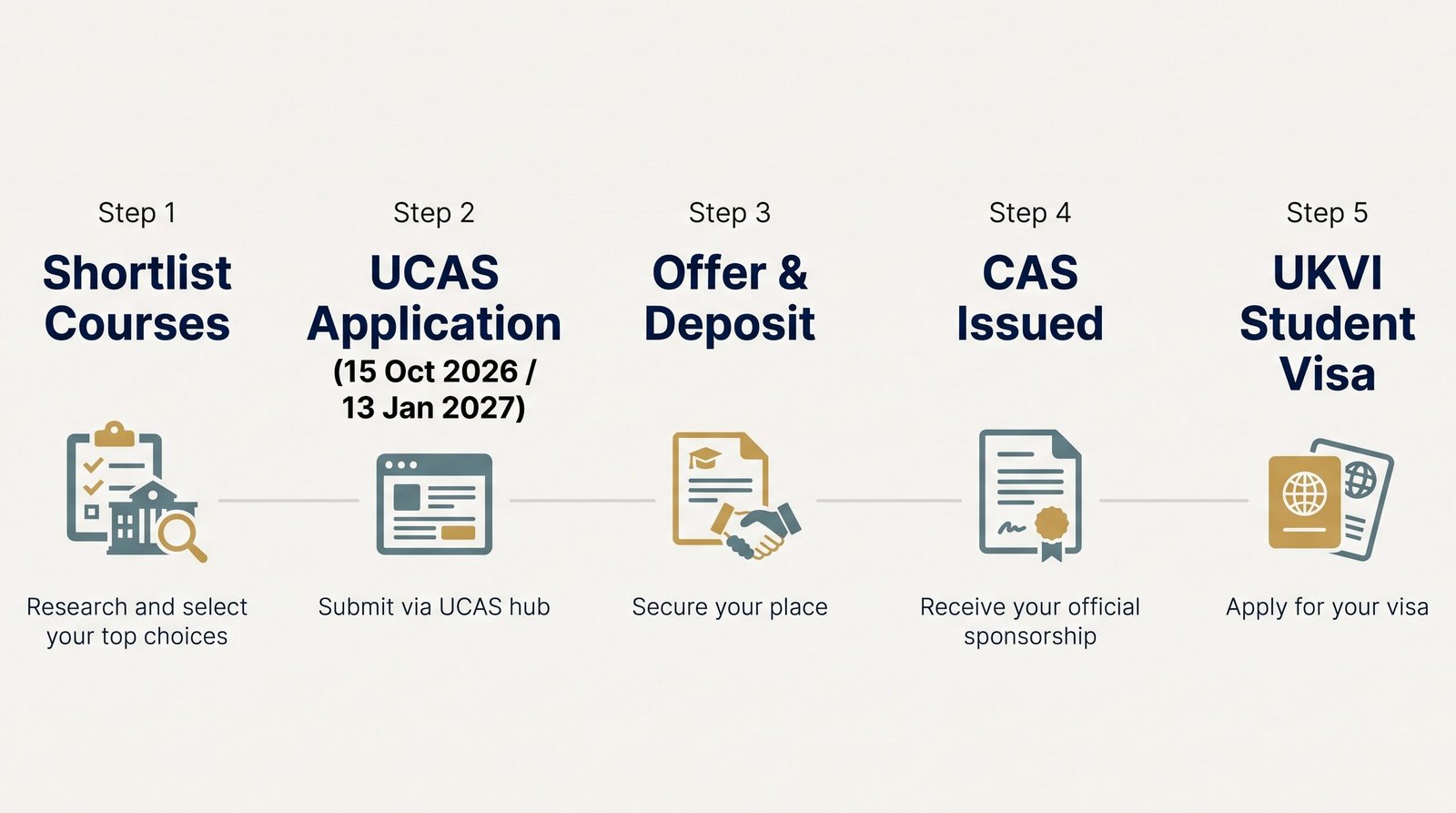
Step-by-Step Workflow to Manage Your London University List
If you feel stuck, break the journey into five clear stages. Following this checklist keeps you organized and protects your deadlines:
- Audit your academic profile and budget: Write down your predicted or achieved grades and English test readiness. Calculate a realistic annual budget covering both tuition fees and London living costs.
- Shortlist 4 to 5 realistic options: Build a balanced London university list with aspirational, matched, and backup choices. Include September and January intake options if your timeline is tight.
- Verify official entry criteria and funding: Check each course page for subject prerequisites, interviews, and scholarship deadlines. UK residents should check GOV.UK Student Finance eligibility early.
- Prepare a clean document pack: Gather certified transcripts, degree certificates, a tailored personal statement, and references. Keep passport copies and bank statements ready in UKVI-compliant formats.
- Submit on time and track your portal: Apply before 13 January 2027 for standard undergraduate courses (or 15 October 2026 for Oxbridge and Medicine). Reply quickly to interview invites and request your CAS as soon as your offer is unconditional.
How Working With an Education Consultancy Helps With London Universities
Juggling UCAS rules, fee assessments, personal statements, and CAS checks alongside work or school is tough. Working with an experienced educational advisory team can simplify the application process and help you avoid administrative errors.
A qualified consultant never promises guaranteed admission or guaranteed visa approval. Final decisions always rest with the universities and UK Visas and Immigration. Instead, an advisory team helps strengthen your application and matches your profile to realistic courses. We also review your documents for completeness to mitigate the risk of administrative delays. Learn more in our education consultant study abroad guide.
Start Your London University List Application With Uni Student Hub
At Uni Student Hub, we are a dedicated UK-based education consultancy and student recruitment agency in central London. We help students secure places across the UK. And also partner with leading institutions across Europe, the USA, Canada, Australia, and New Zealand.
We support UK home students, mature learners, and applicants comparing universities in London for international students. Our team guides you through course selection, personal statement reviews, Student Finance signposting, interview prep, and CAS readiness checks.
Ready to turn your London university list into a clear action plan? Reach out to our London team today:
- Phone: +44 7756428968
- Email: info@unistudenthub.com
- Office: 107 Fleet St, London EC4A 2AB
- Online: Contact Uni Student Hub or explore our international students hub
Frequently Asked Questions About the London University List
How many universities are in London, and how do I choose?
London has over 40 higher education providers, including multi-faculty universities, specialist schools, and modern career-focused institutions. To narrow your shortlist of London universities, filter by course accreditation, tuition fee band, and campus zone. Also check whether the university offers January or September intakes.
How much money do international students need for a London Student visa?
Under current GOV.UK Student visa financial rules, London applicants must show £1,529 per month for up to 9 months (£13,761 total) for living costs. You must also show funds for any unpaid first-year tuition fees. Because exemptions depend on your nationality and circumstances, always verify the latest official guidance before applying.
Can international students work part-time at London universities?
Most full-time international students on a degree-level course (RQF level 6 or higher) at a compliant sponsor can work up to 20 hours per week during term time. You can also work full-time during official vacations, as outlined by UKCISA. However, work rules vary by course level and immigration status, so always check your visa conditions first.